Djibouti
A tropical desert nation on the Red Sea gateway of the Horn of Africa, famed for the salt flats of Lake Assal, the chimney-like landscapes of Lake Abbe, whale shark diving, and a strategic deep-water port.
Djibouti (Republic of Djibouti)
| Capital | Djibouti City |
|---|---|
| Continent | Africa |
| Languages | French, Arabic |
| Currency | Djiboutian franc (DJF Fdj) |
| Time Zone | UTC+3 |
| Dialling Code | +253 |
| Area / Population | 23,200 square kilometers / Approximately 1.1 million |
| Visa | Most foreign visitors can obtain a visa on arrival at major entry points or apply online for an e-Visa in advance. A passport valid for at least 6 months, round-trip flight tickets, and hotel reservations are required. Please refer to the latest announcements from Djibouti’s immigration authorities and the nearest embassy or consulate for visa policies. |
| Best Season | The climate is relatively mild from November to March, making it the best season for travel and diving, with the peak period for whale shark sightings from around October to January. From April to September, it is extremely hot, with coastal temperatures often exceeding 40°C. |
| Main Cities | Djibouti City, Lake Assal, Lake Abbe, Tadjoura, Arta, Dikhil, Seven Brothers Islands |
Djibouti in Detail
Overview of Djibouti
Djibouti (officially the Republic of Djibouti) is located in the Horn of Africa in northeastern Africa, bordering the Gulf of Aden to the east, Eritrea to the north, Ethiopia to the west and southwest, Somalia to the southeast, and facing Yemen across the Bab-el-Mandeb Strait. It covers an area of approximately 23,200 square kilometers, making it one of Africa’s smaller countries. The capital, Djibouti City, serves as the national center of politics, economy, and culture, as well as the most important port city in the Horn of Africa. The official languages are French and Arabic, while Somali and Afar are widely spoken among the public.
Djibouti controls the strategic Bab-el-Mandeb Strait, the gateway from the Red Sea to the Gulf of Aden, through which a significant portion of global maritime trade and energy transport passes. This has given the country a highly prominent strategic position, attracting several nations to establish overseas military bases and logistics hubs here. With a population of about 1.1 million, the country is primarily composed of two major ethnic groups: the Issa (a subgroup of the Somali people) and the Afar, along with Arab and Southern European descendants. The population is predominantly Muslim, and the social atmosphere is relatively open.
Geography and Climate
Djibouti’s terrain is dominated by lava plateaus, volcanic rock platforms, and salt lake basins, with mountains and deserts covering most of the country. Lake Assal in the west lies about 155 meters below sea level, making it the lowest point on the African continent and the second-lowest land depression in the world after the Dead Sea. The lake has extremely high salinity, surrounded by salt pans and white salt crusts, and salt production is a traditional local industry. Lake Abbe in the northwest, near Ethiopia, is known for its dramatic landscape of limestone chimneys (also called chimney-like rock formations), where geothermal steam and mineral deposits create an otherworldly, alien-like terrain that has been used as a film location.
The waters of the Gulf of Tadjoura and Ghoubbet al-Kharab off the eastern coast are rich in plankton, attracting whale sharks from around October to January each year, making it one of the world’s renowned diving destinations. The Goda Mountains in the northern part of the country are home to the Forêt du Day, a rare mountainous forest area and habitat for various endemic bird species, known as the “green heart” of Djibouti.
The climate is tropical desert, characterized by high temperatures and little rainfall throughout the year. The coastal areas are particularly hot and humid, with summer temperatures often exceeding 40°C, earning it a reputation as one of the hottest capitals in the world. The country has almost no permanent rivers, and freshwater is heavily dependent on groundwater and desalination. The period from November to March is relatively cooler and is the most suitable time for travel, while the rest of the year requires preparation for heat and hydration.
Historical Background
The Horn of Africa, where Djibouti is located, has long been a trade route connecting the African interior, the Arabian Peninsula, and the Indian Ocean. Arab merchants established coastal settlements here early on, and Islam was introduced in the process. In the second half of the 19th century, France signed agreements with local Afar and Issa tribal leaders to compete for control of the Red Sea entrance. In 1888, the Port of Djibouti was established, and in 1896, the region became French Somaliland (Côte française des Somalis), serving as a French colonial and shipping outpost in East Africa.
After World War II, the status of French Somaliland within the French system underwent several adjustments. In 1967, it was renamed the French Territory of the Afars and the Issas. After a long struggle, Djibouti officially gained independence on June 27, 1977, becoming the Republic of Djibouti, with Hassan Gouled Aptidon as its first president. Since independence, Djibouti has relied on its ports, railways, and transit trade for its economy and has long played a role as a regional mediator and logistical hub.
Economy and Currency
Djibouti’s economy is highly dependent on port and logistics services. The Port of Djibouti is the most important gateway for Ethiopian imports and exports, and the railway connecting Djibouti City with Addis Ababa serves as a key artery for regional logistics. The development of the multi-purpose Doraleh Port, the international free trade zone, and the free port have further strengthened its role as a transit hub. Additionally, revenue from financial services, telecommunications, infrastructure, and services related to foreign military presence also play significant roles, though exports of salt and livestock are limited. Due to the lack of natural resources and arable land, the country relies heavily on imports for food and daily necessities, resulting in relatively high prices.
The official currency of Djibouti is the Djiboutian franc (DJF), issued by the Banque Nationale de Djibouti. It has long been pegged to the US dollar at a fixed exchange rate of approximately 1 USD to 177.721 DJF since 1973, making it one of the most stable currencies in Africa in terms of exchange rate fluctuations. The US dollar is widely accepted in many foreign-related establishments across the country.
Culture and Society
Djibouti’s culture is a blend of Somali, Afar, Arab, and French influences. The Issa and Afar ethnic groups, residing in urban and rural areas respectively, maintain nomadic traditions, poetry recitals, and tribal customs. Islam profoundly shapes daily life and festivals, with Ramadan and Eid al-Fitr significantly altering the pace of society. The cuisine mainly features grilled lamb, stewed beans, flatbreads, and Arabic-style rice, with fresh seafood available along the coast. French influence is also evident in the prevalence of French bread and coffee culture.
Music and dance are integral parts of Djiboutian social life, with traditional drumming and modern African pop music featured at weddings and festivals. As a port city, Djibouti City is highly inclusive of foreign cultures, with the Central Market, Old Town, and mosques collectively presenting a unique blend of African, Arab, and Mediterranean characteristics.
Tourism Overview
Djibouti’s tourism highlights are centered around geological wonders and marine experiences: the white salt flats and the Low Point Monument of Lake Assal, the limestone chimneys of Lake Abbe, the volcanic landscapes of Ardoukoba, the mountain scenery of Forêt du Day, as well as diving, snorkeling, and swimming with whale sharks in the Gulf of Tadjoura and Musha Island—all offer highly distinctive experiences. Djibouti City itself also has attractions such as the Central Market, European-style Old Town, and seaside promenade, with nearby fishing ports and salt flats offering half-day excursion options.
It is important to note that certain border areas with Eritrea, Somalia, and Ethiopia as well as parts of adjacent coastal waters pose security risks. Travelers should avoid border areas and sensitive regions, opt for group tours or guided excursions organized by reputable agencies, refrain from venturing into remote locations, stay updated on the latest consular information, and purchase travel insurance that includes emergency evacuation and medical transport. The local climate is hot, and medical resources are limited, so travelers should prepare in advance with sun protection, hydration, mosquito repellent, and essential medications.
Local Currency: Djiboutian franc (DJF)
Currency Overview
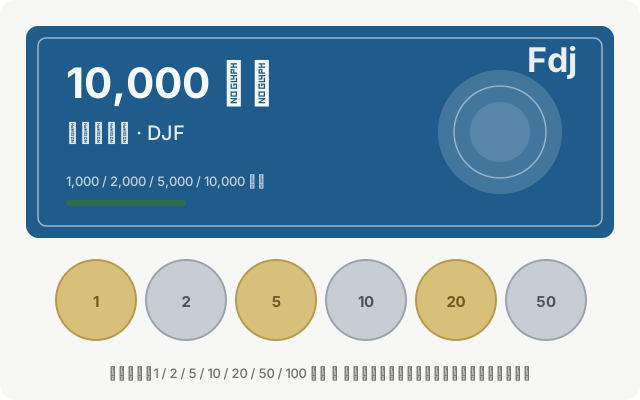
The official currency of Djibouti is the Djiboutian franc (currency code DJF, symbol Fdj), issued by the Banque Nationale de Djibouti. One Djiboutian franc is divided into 100 centimes, but centimes are virtually non-existent in circulation. The most notable feature of the Djiboutian franc is its long-standing fixed exchange rate peg to the US dollar, set at approximately 1 USD to 177.721 DJF since 1973, a policy that continues to this day. This stability makes Djibouti one of the economies with the least volatile currency in Africa. The US dollar is widely accepted in many hotels, foreign-related shops, and long-distance car hire services across the country.
Denomination System
Circulating Djiboutian franc banknotes are mainly issued in denominations of 1,000, 2,000, 5,000, and 10,000 francs. The notes feature themes such as the country’s ports, mosques, camel caravans, and natural landscapes, with distinct color schemes for different denominations and modern anti-counterfeiting designs. Smaller denominations of 20, 50, 100, and 500 francs have largely been replaced by coins. Coin denominations include 1, 2, 5, 10, 20, 50, 100, 250, and 500 francs, with lower-value coins typically made of aluminum and commonly used in change and small purchases. Due to the higher purchasing power of larger denomination notes, it is advisable to distribute them when carrying cash.
Cash and Payment Habits
Electronic payments and card usage are not widespread in Djibouti, and cash is the primary method of payment for daily transactions. International credit cards are generally accepted only at a few star-rated hotels, banks, and foreign-related restaurants in Djibouti City. Markets, taxis, street food vendors, and small stalls in salt lake and desert areas almost exclusively accept cash. US dollars can be exchanged for Djiboutian francs at banks and authorized exchange offices, with exchange rates close to the official fixed rate, ensuring transparency. Since many inland excursions and diving activities require advance cash payment to tour operators and guides, it is recommended to carry sufficient cash in Djibouti City and keep some US dollars for hotel expenses or larger purchases.
Traveler Tips
- It is recommended to carry mainly US dollars in cash, and exchange them for Djiboutian francs at banks or authorized exchange offices upon arrival, as the fixed exchange rate simplifies the process.
- Keep smaller denominations such as 1,000 and 2,000 francs for convenient payment of transportation fares, entrance fees, and market purchases.
- Cash is essential as card payment options are limited, especially in desert and salt lake areas where cards are generally not accepted—bring enough cash.
- The Djiboutian franc has very limited usability abroad, so try to use up or exchange any leftover cash for US dollars before departure.
- Carry newer versions of US dollar bills, as older or heavily marked notes may be refused.
Flag Meaning
Flag Design
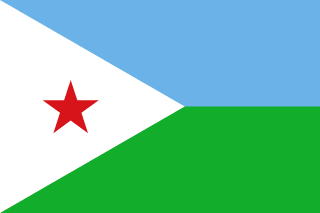
The flag of Djibouti features a horizontal bicolor design, with light blue on the top and light green on the bottom. On the hoist side, there is a white isosceles triangle, with a red five-pointed star in the center. The flag has an aspect ratio of approximately 2:3. The color scheme is fresh and bright, with the white triangle and red star forming a striking visual focus. Compared to the flags of other East African nations, it has a more geometric design. The combination of light blue and light green reflects the sea, sky, and land of the region, giving it a coastal landscape appearance reminiscent of the Horn of Africa.
Symbolism
The light blue represents the ocean and sky, symbolizing the Red Sea and Gulf of Aden, as well as the Issa people. The light green symbolizes the land and vegetation, representing the Afar people and signifying life and hope. White stands for peace and purity. The central red five-pointed star symbolizes national unity and the spirit of striving for independence. Some interpretations also suggest it represents the unity of all ethnic groups under the republic’s banner. The pairing of the two base colors also refers to the two major ethnic groups, visually expressing Djibouti’s national ideal of peaceful coexistence among diverse communities.
History and Legal Status
The flag of Djibouti was officially adopted on June 27, 1977, the day of the country’s independence, and was designed by the then-national liberation front fighting for independence. The flag’s colors are based on the symbolic hues of the Issa and Afar peoples, reflecting the political aspiration for ethnic reconciliation and national unity after independence. Since independence, the flag has been enshrined in the constitution and relevant laws, and is widely used on National Day, at government institutions, schools, and foreign-related entry points. Today, the light blue, light green, white triangle, and red star have become Djibouti’s most distinctive national symbols on the international stage, appearing on ports, embassies, sports teams, and official documents.
Djibouti Travel Guide
All Guides »Djibouti Pre-Travel Quick Guide: Visa, Seasons, Budget & Border Safety Tips
Before deciding how to explore Djibouti’s salt lakes and dive sites, make sure y...
Classic 7-Day Route in Djibouti: Djibouti City – Arta – Tadjoura – Lake Assal – Lake Abbe 7 days
Using Djibouti City as a hub, this route connects salt lakes, volcanic landscape...
Djibouti 4-Day Short Trip: Djibouti City + Lake Assal + Diving in the Gulf of Tadjoura 4 days
Even with limited time, you can experience the highlights: a salt lake geologica...
Essential Attractions in Djibouti: Salt Lakes, Wilderness, and the Gulf of Tadjoura
A regional guide to the top sights in Djibouti, with highlights and recommended ...
Djibouti Food Guide: Lamb Rice, Seafood, and Arabic Flavors
Sample a mix of Arabic, Somali, and French cuisines: from spiced lamb rice to Gu...
Djibouti Travel Guide: Airport Transfers, Private Cars, and Sea Trips
Djibouti has no passenger rail service or well-developed public transport. Priva...
10 Practical Tips for Traveling in Djibouti
From visas and cash to border safety, these details can make or break your trip ...