Slovakia
A landlocked Central European mountainous country, known across Europe for the snow-capped peaks of the High Tatras, hundreds of castles, and statues peeking out from old towns.
Slovakia (Slovak Republic)
| Capital | Bratislava |
|---|---|
| Continent | Europe |
| Languages | Slovak |
| Currency | Euro (EUR €) |
| Time Zone | UTC+1 to UTC+2 (UTC+2 during daylight saving time) |
| Dialling Code | +421 |
| Area / Population | Approximately 49,000 square kilometers / Approximately 5.4 million |
| Visa | Slovakia is part of the Schengen Area and the Eurozone. Most foreign visitors need to apply for a Schengen short-stay visa (Category C) in advance, typically for stays of up to 90 days. Applications must be submitted to the Slovak embassy or visa center in your own country, and should include details of your itinerary, accommodation, and travel insurance. Travelers holding a valid Schengen visa may enter Slovakia through any other Schengen country. |
| Best Season | The months from May to September offer pleasant temperatures, ideal for hiking in the High Tatras and castle tours; December to March is ski season, with Christmas markets in Bratislava concentrated in December. |
| Main Cities | Bratislava, Košice, Žilina, the High Tatras, Poprad, Banská Bystrica, Nitra, Trnava, Bardejov |
Slovakia in Detail
Slovakia Overview
Slovakia (Slovenská republika) is a landlocked country located in Central Europe. It became an independent sovereign state on January 1, 1993, after peacefully separating from Czechoslovakia through negotiation, an event historically referred to as the 'Velvet Divorce.' It borders Ukraine to the east, Hungary to the south, Austria and the Czech Republic to the west, and Poland to the north. The country covers an area of approximately 49,000 square kilometers, with a population of about 5.4 million. The official language is Slovak, and its capital, Bratislava, is situated on the Danube River, adjacent to both Austria and Hungary, making it one of the few capitals in the world that borders two neighboring countries.
Slovakia operates under a parliamentary republic system, with the president as the head of state and the prime minister holding executive power. It joined the EU and NATO in 2004, adopted the euro on January 1, 2009, and is a member of the Eurozone. It is also one of the more economically open countries in Central Europe.
Geography and Climate
Slovakia lies in the western part of the Carpathian Mountains, with a terrain dominated by mountains. The High Tatras, Low Tatras, and Greater Fatra mountains stretch across the northern and central regions. Gerlachovský štít, the highest peak in the High Tatras at 2,655 meters above sea level, is the tallest in the Carpathian range and a core area for mountaineering and skiing in Central and Eastern Europe. The southern and southeastern parts consist of lowlands formed by the Danube, Váh, and Hornád rivers, which are more agriculturally developed. Forests cover over 40% of the country, and karst landscapes have created numerous caves, several of which are listed as UNESCO World Natural Heritage sites.
The climate is temperate continental, with distinct seasons: cold and snowy winters, especially in the mountains where snow cover lasts long, making it peak ski season; mild summers, with average July temperatures around 20°C, ideal for hiking and exploring castles. The period from May to September is the most comfortable time to visit, while autumn offers colorful and layered mountain scenery, excellent for photography.
Historical Background
The region of Slovakia was the heart of the Great Moravian Empire in the 9th century. Saints Cyril and Methodius preached here, creating the Glagolitic script and laying the foundation for Slavic literature. From the 11th century onward, Slovakia gradually became part of the Kingdom of Hungary, and for nearly a millennium, its history was closely intertwined with that of Hungary and Austria. After the Ottoman capture of Buda in 1526, Bratislava briefly served as the capital and coronation site of the Kingdom of Hungary, with St. Martin’s Cathedral witnessing the coronations of multiple Hungarian kings and queens.
Following the dissolution of the Austro-Hungarian Empire in 1918, Slovakia and the Czech lands merged to form Czechoslovakia. A short-lived client state emerged in 1939 just before World War II, but it rejoined Czechoslovakia afterward. From 1948, it adopted a socialist path. After the Prague Spring in 1968, it became a federation, and the one-party rule ended with the Velvet Revolution in 1989. On January 1, 1993, Czechoslovakia peacefully split into the Czech Republic and Slovakia, the latter becoming an independent nation. It joined the EU and NATO in 2004 and adopted the euro in 2009, achieving leading economic and social development in Central and Eastern Europe.
Economy and Currency
Slovakia is an important manufacturing economy in Central and Eastern Europe, particularly prominent in the automotive industry. Major car manufacturers such as Volkswagen, Kia, Peugeot Citroën, and Jaguar Land Rover have factories here. Its per capita car production has long ranked among the highest in the world, earning it the nickname 'the Detroit of Europe.' Electronics, machinery, metallurgy, and information technology also play important roles. The cross-border metropolitan area formed by the capital Bratislava, Austria, and the Czech Republic is a hub for foreign investment. Slovakia joined the Eurozone in 2009, and its official currency is the euro. Banknotes are issued by the European Central Bank system, while coins feature national designs. Slovak euro coins depict Bratislava Castle, the double-cross on three hills emblem, and Kriváň Mountain on their reverse sides.
Culture and Society
Slovak culture is rooted in Slavic traditions, with well-preserved folk music, puppetry, embroidery, and wooden architecture. Traditional villages like Vlkolínec still retain original wooden house settlements. The cuisine is influenced by neighboring cultures but has its own distinct character. Bryndza (sheep cheese) is a national delicacy, and potato dumplings with bryndza and bacon are considered a national dish. Other common traditional foods include sour cabbage soup, stewed pork with sauerkraut, potato pancakes, and steamed sweet buns. Plum brandy and juniper spirits are typical drinks served before or after meals. The 'Man at Work' statue, Blue Church, and St. Martin’s Cathedral in Bratislava’s Old Town add unique charm to this small capital.
Tourism Overview
Slovakia boasts a dense concentration of natural and cultural attractions: the High Tatras offer trails ranging from easy walks to challenging hikes, suitable for summer trekking and winter skiing; Spiš Castle is one of the largest castle ruins in Central Europe and, along with the nearby Spišské Podhradie, is a UNESCO World Heritage Site; Bardejov, Banská Štiavnica, and Vlkolínec are also listed heritage sites. Bratislava, with its convenient transport links, serves as a great stopover between Vienna and Budapest, or as a gateway to the mountains for exploring the Carpathians and thermal spa towns. Overall prices are lower than in Western Europe, making it ideal for combining with Austria, Hungary, and the Czech Republic on a Central European itinerary.
Local Currency: Euro (EUR)
Currency Overview
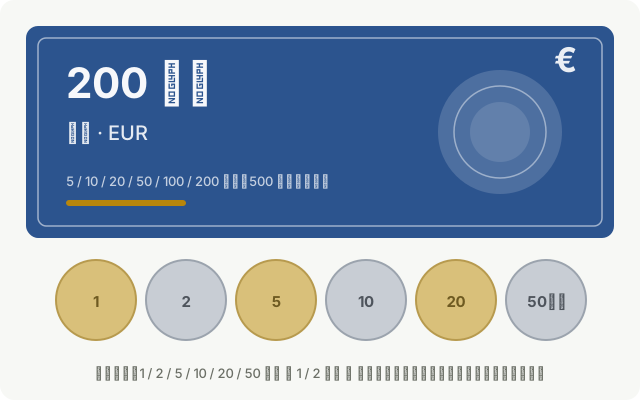
Slovakia officially adopted the euro on January 1, 2009, and its legal tender is the euro (currency code EUR, symbol €), with 1 euro equal to 100 cents. Euro banknotes are uniformly issued by the European Central Bank system, while coins can feature nationally distinctive designs on the reverse side. Prior to this, Slovakia used the Slovak koruna (SKK), which was converted to euros at a fixed rate of approximately 30.126 SKK to 1 euro in 2009. The euro is the sole legal tender throughout Slovakia, and there is no need to exchange currency when traveling to border areas with Austria or Hungary.
Denomination System
Euro banknotes come in seven denominations: 5, 10, 20, 50, 100, 200, and 500 euros, with varying colors and sizes. The 500 euro note is no longer issued but remains a legal means of payment. There are eight coin denominations: 1, 2, 5, 10, 20, 50 cents, and 1 and 2 euros, with the 1 and 2 euro coins being bimetallic. Coins minted in Slovakia feature the following designs: 1, 2, and 5-cent coins show the Kriváň double peaks; 10, 20, and 50-cent coins depict Bratislava Castle; and 1 and 2 euro coins show the double-cross on three hills, Slovakia’s national coat of arms. Like all euro coins, these are accepted throughout the Eurozone.
Cash and Payment Habits
Slovakia is relatively modern in terms of payments within the Eurozone. Card payments and contactless transactions are widely accepted in shopping malls, supermarkets, restaurants, and gas stations. Visa, Mastercard, and UnionPay are generally accepted at most major merchants, and the adoption of Apple Pay and Google Pay is also fairly high. Cash is still necessary in smaller towns, rural restaurants, markets, and some bus lines, especially as a few bus and mountain transport operators may only accept cash or local transit cards. ATMs are widely available in cities and town centers. When withdrawing cash, choose transactions in euros to avoid dynamic currency conversion fees.
Traveler Tips
- Slovakia uses the euro, making travel very convenient with no need for currency exchange with other Eurozone countries such as Austria and Germany.
- Some buses and mountain cable cars only accept cash or local transit cards, so carry small amounts of euro change.
- When using ATMs, select transactions in euros and decline options to pay in other currencies.
- Slovakia does not have a strong tipping culture. Service charges are not usually included in bills, so you may leave 5–10% based on satisfaction.
Flag Meaning
Flag Design
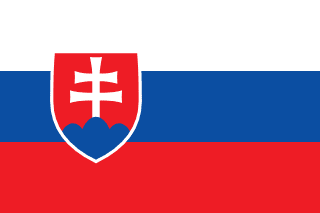
The Slovak flag consists of three horizontal stripes in white, blue, and red, arranged from top to bottom in a 2:3 ratio, belonging to the typical Pan-Slavic color scheme. On the side near the flagpole, above the white-blue-red stripes, is the national coat of arms: a red shield featuring a white double cross (patriarchal cross) standing on three blue hills. The left side of the flag leaves enough space so that the coat of arms fully covers the three stripes, which is the most distinguishing feature between the Slovak and Russian flags.
Meaning
The white, blue, and red colors are the traditional hues of Slavic nations: white symbolizes purity and peace, blue represents loyalty and fidelity, and red stands for courage and the blood shed for freedom. The white double cross in the shield originates from Byzantine church tradition, brought to the Slavic world by Cyril and Methodius, representing the Christian heritage of the nation. The three blue hills are commonly interpreted as symbolizing three important Slovak mountain ranges—the Tatra, Fatra, and Matra mountains—and also signify that the nation is founded among mountains.
History and Legal Status
The white-blue-red tricolor flag was used by the Slovak national movement during the European revolutions of 1848. During the Czechoslovak era, Slovakia did not have an independent flag for a long time under the federal system. In 1992, to distinguish itself from other countries like Russia and Slovenia that also used the white-blue-red palette, Slovakia added the national coat of arms to the left side of the flag. This design was adopted by the Slovak National Council on September 1, 1992, and officially took effect on January 1, 1993, when the country gained independence. Today, the Slovak flag is widely used in government buildings, schools, sports events, and national celebrations, together with the national anthem 'Lightning Over the Tatras,' forming the symbols of the state.
Slovakia Travel Guide
All Guides »Slovakia Travel Quick Guide: Schengen Visa, Best Seasons, Budget, and High Tatras Mountain Safety
How to get a visa, when is the best time to visit, how much to budget per day, a...
Classic 7-Day Slovakia Itinerary: Bratislava – High Tatras – Spiš – Košice 7 days
Traveling eastward from the small capital on the Danube River, this route combin...
Slovakia 4-Day Itinerary: Bratislava and the Little Carpathian Wine Route 4 days
Based in Bratislava, spend 4 days exploring the Old Town, Devín Castle, and wine...
Must-visit attractions in Slovakia: the capital, the High Tatras, and medieval UNESCO World Heritage Sites
From the white castle by the Danube River to alpine lakes in the Carpathians, an...
Slovakia Food Guide: Bryndzové Halušky, Hearty Stews & Aperitifs
Sheep cheese, potatoes, and sauerkraut form the flavor foundation of Slovak cuis...
Slovakia Transportation Guide: Bratislava Airport, Trains & Mountain Buses
How to get from Bratislava Airport into the city, how to buy tickets for interci...
Practical Travel Tips for Slovakia: 11 Details on Schengen Visas, Mountain Hiking & Euro Payments
Pack travel apps, carry euro coins, check mountain weather, and follow trail rul...