Palau
An archipelago nation in the western Pacific known for its coral reefs, Jellyfish Lake, and world-class dive sites.
Palau (Republic of Palau)
| Capital | Ngerulmud |
|---|---|
| Continent | Oceania |
| Languages | Palauan, English |
| Currency | US Dollar (USD $) |
| Time Zone | UTC+9 |
| Dialling Code | +680 |
| Area / Population | 459 square kilometers / Approximately 18,000 |
| Visa | Most foreign visitors traveling to Palau for tourism can apply for a 30-day entry permit upon arrival with a return ticket, hotel reservation, and proof of funds, along with payment of the Palau Environmental Protection Fee. Please check the latest announcements from the Palau Immigration Office before traveling. |
| Best Season | The dry season runs from November to April, featuring calm seas and high visibility, making it the best time for snorkeling and diving. The rainy season is from July to October, with possible effects from typhoons. |
| Main Cities | Koror, Ngerulmud, Melekeok, Babeldaob Island, Peleliu, Angaur, Aimeliik |
Palau in Detail
About Palau
Palau (officially the Republic of Palau) is located at the boundary between the Philippine Sea and the Pacific Ocean in the western Pacific, about 1,300 kilometers southwest of Guam and approximately 880 kilometers east of Mindanao in the Philippines. It consists of over 340 islands of varying sizes, with a land area of just around 459 square kilometers and a population of about 18,000, making it one of the least populous countries in Oceania. The country has 16 states, with its economy and population heavily concentrated in Koror. The official capital, Ngerulmud, is situated on the largest island, Babeldaob, and was moved there from Koror in 2006. The official languages are Palauan and English.
Palau is a presidential republic. On October 1, 1994, it ended its period of administration by the United States and gained full independence. In the same year, it signed the Compact of Free Association (COFA) with the US: the US is responsible for Palau’s defense and may use its military facilities, while Palauan citizens enjoy the right to live, work, and study freely in the US. In return, the US federal government continues to provide financial assistance. This unique relationship is key to understanding Palau’s politics and economy.
Geography and Climate
Palau consists of a chain of islands stretching from northeast to southwest: the volcanic Babeldaob Island in the north, the world-renowned Rock Islands in the center—hundreds of mushroom-shaped limestone islets eroded by the sea and scattered across emerald lagoons—and islands such as Peleliu and Angaur in the south. The surrounding barrier reefs and lagoons create highly diverse marine habitats, with some of the highest coral diversity and fish density in the world.
The climate is tropical maritime, with an average annual temperature of about 27 degrees Celsius and little seasonal variation. The relatively dry season from November to April features calm seas, making it peak season for water activities. The rainy season lasts from June to October with more precipitation. Although Palau lies outside the main typhoon track in the western Pacific and is less directly hit than the Mariana Islands, peripheral typhoon effects can still bring strong winds and heavy rain.
Historical Background
The ancestors of the Palauan people migrated from Southeast Asian islands around 3,000 years ago in outrigger canoes, forming a society centered on matrilineal clans and village communities. Palau first came to Western attention in 1783 when the ship of British captain Henry Wilson was wrecked nearby. Spain subsequently claimed sovereignty over Palau, and in 1899 sold the Caroline Islands—including Palau—to Germany. After World War I, Japan was granted a League of Nations mandate over the South Seas Mandate, and Koror once served as the seat of the Japanese South Seas Bureau. As a result, many Palauan words, as well as a taste for Japanese side dishes, sushi, and miso, remain rooted in the culture today.
During World War II, the Battle of Peleliu in 1944 was one of the Pacific War’s fiercest island campaigns. After the war, Palau became part of the US-administered Trust Territory of the Pacific Islands. Following multiple referendums and lengthy negotiations, it gained independence in 1994 and joined the United Nations. In 2009, Palau established the world’s first national shark sanctuary, and in 2012, the southern lagoon of the Rock Islands was inscribed on the UNESCO World Heritage List, further solidifying its commitment to ecological governance.
Economy and Currency
Palau’s economy is heavily reliant on tourism and fishing, with additional government revenue coming from US aid and licensing fees for foreign fishing vessels. Tourism is positioned as a high-end, niche market, with per capita spending among the highest in the western Pacific. Visitors mainly come from Japan, South Korea, mainland China, and Taiwan. Palau does not issue its own currency; the US dollar (USD) is legal tender, and all transactions—from hotels and dive shops to local markets—are conducted in dollars, reflecting the country’s close ties with the US under the Compact of Free Association.
In recent years, Palau has implemented eco-tourism policies such as the Palau Pledge, which requires incoming visitors to sign a passport pledge to protect the environment. Under the country’s Marine Protected Areas law, about 80% of its exclusive economic zone is designated as no-take zones. This conservation-focused model has made Palau a global example of sustainable marine tourism and ocean governance.
Culture and Society
Palauan society retains a strong traditional character: under the matrilineal system, titles and land are passed down through female lineage; each village has a council of chiefs, and the conferral of traditional titles remains an important social event. Traditional men’s meeting houses called Bai feature painted panels depicting clan stories, while stone platforms and ancient pathways in Aimeliik State showcase the engineering skills of the past. Interestingly, Palau shares a deep cultural connection with Yap (now part of the Federated States of Micronesia) through the stone money tradition—Yapese people once traveled to Palau to quarry limestone for their famous Rai stones.
Modern Palauan life blends tradition with external influences: Sunday church services are a key event for many families, and the culinary scene reflects a mix of Japanese, American, and Southeast Asian flavors. Local drinks like sakau (similar to kava) and betel nut chewing are also common social practices. The people are generally friendly but are deeply concerned about environmental protection, and visitors often receive gentle reminders about their impact on nature.
Tourism Overview
Palau is globally recognized as a top diving destination and honeymoon spot. Experiences such as bathing in the volcanic mud of Jellyfish Lake, swimming with harmless golden jellyfish, wall diving at Blue Corner and Blue Holes, drift diving with manta rays at German Channel, dancing with stingrays at Devil’s Hole, and walking along the white sandbar of Long Beach during low tide are all on the bucket lists of countless travelers. Beyond marine activities, Babeldaob Island offers Ngardmau Waterfall and the northern megalithic site of Badrulchau, while Peleliu preserves well-preserved WWII battlefields. Due to limited flight options and ecological carrying capacity, travel in Palau is relatively costly and paced slowly, making it best suited for travelers focused on diving and marine experiences.
Local Currency: US Dollar (USD)
Currency Overview
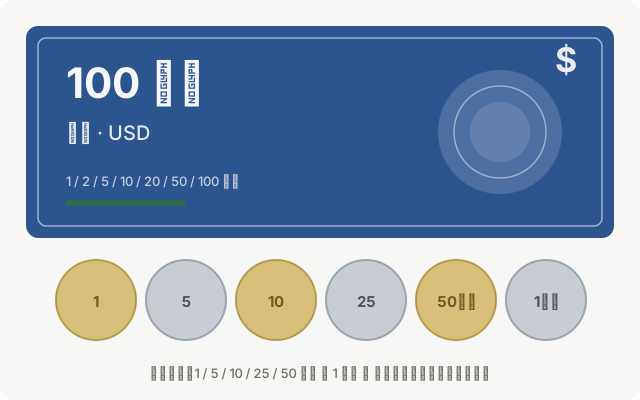
Palau does not have its own currency; the US dollar (currency code USD, symbol $) is the legal tender, a direct result of its Compact of Free Association with the US. All goods and services—from dive shops and resorts in Koror to roadside stalls on Babeldaob—are priced in US dollars. US Treasury-issued banknotes and coins circulate without restriction throughout Palau. Travelers don’t need to worry about a “local currency,” and there’s virtually no currency exchange involved, making budgeting straightforward.
Denominations
The denominations used in Palau are identical to those in the US: banknotes in $1, $2, $5, $10, $20, $50, and $100, and coins in 1¢, 5¢, 10¢, 25¢, 50¢, and $1. Due to Palau’s small population and limited market size, cash is mostly concentrated in banks and businesses in Koror. Some transactions on the outer islands may still be settled with a mix of cash and credit accounts. Small-denomination bills ($1, $5, $10) are the most commonly used in daily life, and larger bills may be harder to break outside of Koror.
Cash and Payment Habits
Koror has several banks and ATMs where travelers can withdraw US dollars using internationally issued Visa, Mastercard, and other debit or credit cards, but the number of machines is limited and queues or temporary shortages may occur during peak seasons. Hotels, dive shops, car rental agencies, and mid- to high-end restaurants generally accept credit cards. However, small shops, taxis, and residents on the outer islands typically only accept cash. Palau does not have a large-scale local mobile payment ecosystem, and services like Apple Pay are only available at a few terminals that support contactless payments.
It is recommended to carry an average of US$100–200 in cash per person per day for meals, tips, dive boat gratuities, and small purchases, with other expenses payable by card. Exchanging US dollars in your home country before departure is the safest option, as local exchange services in Koror are limited and offer less favorable rates.
Tips for Travelers
- US dollars are used throughout Palau with no local currency available, so bring enough US cash before departure.
- ATMs are concentrated in Koror, with almost no cash withdrawal options on the outer islands—get enough cash in advance.
- Tipping is customary for diving and boat tours, with US$10–20 per person per day for guides and boat captains being appropriate.
- Entry fees and environmental protection charges may change—always check the latest updates from official Palau sources and your booking channels.
Flag Meaning
Flag Design
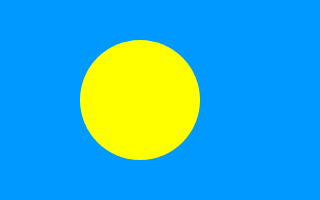
The flag of Palau is a light blue rectangular banner with a yellow circle slightly off-center toward the hoist. The flag’s aspect ratio is 8:5, with the diameter of the yellow circle roughly three-fifths the width of the flag and positioned slightly toward the hoist. The light blue is a bright sky-blue tone, and the yellow circle uses a warm golden-yellow color. The combination is highly distinctive among world flags and is often mistaken for a “simplified version of the Japanese flag,” though the meanings are entirely different.
Meaning
The light blue symbolizes the Pacific Ocean on which Palau depends, as well as the country’s independence and peace. The yellow circle represents a full moon, not the sun. In Palauan tradition, the full moon is considered the most auspicious time: ideal for festivals, canoe building, harvesting, and ceremonies. Farming and fishing activities are scheduled according to the lunar phase, giving the full moon connotations of tranquility, stability, and abundance. Officially, the flag embodies the Palauan wish for the nation to be as complete as the full moon and for its people to endure like moonlight through generations.
History and Legal Status
The flag of Palau was officially adopted on January 1, 1981—thirteen years before independence in 1994—and emerged during a period of accelerated self-governance. It is one of the earlier national symbols established in the South Pacific. The design was selected through a public competition by a local artist. The Palau Constitution, enacted in 1981, along with subsequent flag laws, specify the colors, proportions, and proper usage of the flag.
Today, the Palauan flag is flown at government buildings, schools, airports, and the Koror dock, and is often displayed alongside the Palau Pledge’s environmental message at visitor centers and promotional materials. Thanks to its simple design and vibrant colors, the “Full Moon Flag” has become an important emblem of Palau in the global diving and marine tourism community.
Palau Travel Guide
All Guides »Palau Travel Quick Guide: Entry Permits, Best Seasons, Daily Budget & Coral Reef Rules
Get clear on entry permits and environmental fees, dry season sea conditions, an...
Classic 7-Day Palau Itinerary: Koror — Rock Islands — Babeldaob — Peleliu 7 days
Experience Palau’s top marine highlights in one trip: island-hop through the Roc...
4-Day Short Trip to Palau: Full Experience of Koror Hub and Rock Islands 4 Days
Limited vacation time? Still experience the best of Palau: warm up in the lagoon...
Must-visit attractions in Palau: from Jellyfish Lake in Rock Islands and Blue Corner dive site to Peleliu Battlefield
A themed guide to the 12 most worthwhile attractions in Palau, covering three ma...
Palau Food Guide: Tuna Sashimi, Bat Soup, and Island Flavors with a Coconut Twist
The Palauan dining scene is a blend of Japanese, American, and Pacific flavors: ...
Complete Guide to Transportation in Palau: International Flight Connections, Koror Car Rentals, and Inter-Island Ferry Schedules
Palau has no direct flights from many parts of the world. Getting to and from th...
Nine practical tips for Palau: marine protected areas, ferry schedules, cash and tipping
Nine practical tips from local itineraries covering marine protected areas, weat...