Eswatini
A landlocked kingdom in southern Africa, it changed its name to Eswatini in 2018. This ancient monarchy is famed for its royal wildlife reserves, the Reed Dance cultural festival, and mountain safaris.
Eswatini (Kingdom of Eswatini)
| Capital | Mbabane |
|---|---|
| Continent | Africa |
| Languages | English, SiSwati |
| Currency | Swazi Lilangeni (SZL E) |
| Time Zone | UTC+2 |
| Dialling Code | +268 |
| Area / Population | Approximately 17,400 square kilometers / Approximately 1.2 million |
| Visa | Most foreign visitors need to apply for a visa in advance through Eswatini’s embassies or consulates abroad. Most travelers enter via Johannesburg, South Africa, or overland, and should also confirm South African transit visa and multiple-entry requirements. |
| Best Season | The dry season from May to September is cool and dry, making it the best time for wildlife viewing; the rainy season from October to April sees lush vegetation but muddy roads. |
| Main Cities | Mbabane, Lobamba, Manzini, Ezulwini Valley, Piggs Peak, Siteki, Nhlangano |
Eswatini in Detail
Eswatini Overview
Eswatini (also known as Eswatini), located in inland southern Africa, borders Mozambique to the east and is surrounded by South Africa on the other three sides. It covers an area of approximately 17,400 square kilometers and has a population of around 1.2 million. On its Independence Day in 2018, King Mswati III announced the change of the country’s English name from Swaziland to Eswatini (meaning "land of the Swazi people") to avoid confusion with Switzerland and to strengthen national identity. Both the old and new names are still used internationally, but this site uses the commonly known name “Eswatini.”
It is one of the few countries in the world that retains a traditional monarchy. The king is both the head of state and the supreme authority of the Swazi nation. The administrative capital is Mbabane in the west, while Lobamba is the seat of the monarchy and legislature, housing the royal palace and parliament buildings. The two cities are about 20 kilometers apart and, together with the Ezulwini Valley in between, form the political and cultural core of the country.
Geography and Climate
The country is divided into four longitudinal zones from west to east: the Highveld in the west, mostly above 1,000 meters in elevation with a cool climate—Mbabane is located here; the Middleveld in the center, which is the most densely populated; the Lowveld in the east, a low-lying, hot, and dry region that is home to sugarcane plantations and wildlife reserves; and the Lubombo Ridge in the far east, separating the plains of Mozambique. The highest peak, Emlembe (1,862 meters), lies on the western border.
The climate varies significantly with altitude: the highlands have a temperate climate, with winter (June–August) mornings nearing freezing; the lowlands have a subtropical climate, with hot, humid, and rainy summers (October–March). The dry season from May to September offers clear skies, short grass, and animals gathering around water sources, making it ideal for safari.
Historical Background
The Swazi people are part of the southern Nguni group. In the late 18th century, under King Ngwane III, they migrated south to their current territory and gradually established a unified monarchy. The reign of King Mswati II in the 19th century marked the kingdom’s peak, and his name continues to be used today. In the late 19th century, Boer settlers from the Transvaal and British forces became involved, and in 1903 the region became a British protectorate. It gained independence on September 6, 1968, taking the name Swaziland, with King Sobhuza II ruling until 1982—over sixty years—making him a central figure in the country’s modern history.
In 1973, King Sobhuza II repealed the constitution enacted at independence and restored traditional monarchical authority. King Mswati III ascended the throne in 1986. A new constitution was promulgated in 2005, retaining the king’s powers and establishing a bicameral parliament. The renaming to Eswatini in 2018 was one of the country’s most internationally notable events in recent years.
Economy and Currency
The economy is driven by agriculture and manufacturing: sugar and wood pulp are the top exports, along with light industries such as beverages, textiles, and food processing. The service and tourism sectors are growing steadily. The economy is closely tied to South Africa, and the country is a member of the Southern African Customs Union and the Common Monetary Area. The official currency is the Lilangeni (SZL), which is pegged 1:1 to the South African Rand, which is also legal tender and circulates freely alongside the Lilangeni—see the currency section below for details.
Culture and Society
Swazi culture remains well preserved. SiSwati and English are both official languages, and most residents are Christian while also maintaining ancestral worship and traditional royal customs. The Umhlanga Reed Dance, held annually from late August to early September, is the most important cultural event: tens of thousands of unmarried girls from across the country gather at the Queen Mother’s residence to collect reeds, perform dances, and present them to the royal family as a tribute to the king. In practice, it is both a vibrant expression of Swazi cultural identity and a major royal event, attracting many domestic and international tourists. However, photography is strictly limited during the key ceremonial moments, so always follow local regulations.
Handicrafts are also outstanding: the Ngwenya Glass studio creates colorful glassware from recycled materials, and its products—along with batik fabrics, wood carvings, and grass weaving—are well known across southern Africa and are popular souvenirs for visitors.
Tourism Overview
Though small, the country packs in a variety of experiences including safari, culture, and mountains: Hlane Royal National Park is known for white rhinos and elephant herds, Mlilwane Wildlife Sanctuary allows close walking encounters with zebras and wildebeest, and Mkhaya Reserve focuses on black rhino conservation; Mantenga Cultural Village features traditional dance and waterfall trails; and Sibebe Rock is the world’s second-largest granite monolith. Since most visitors arrive via South Africa, many combine it with Kruger National Park for a classic “big and small” southern African safari route.
Local Currency: Swazi Lilangeni (SZL)
Currency Overview
The official currency of Eswatini is the Lilangeni (singular: lilangeni, plural: emalangeni), with the currency code SZL. It is often written with the symbol E preceding the amount (e.g., E100). The currency is issued by the Central Bank of Eswatini. As a member of the Common Monetary Area, the Lilangeni is pegged 1:1 to the South African Rand, which is also legal tender in the country and circulates freely at equal value. This dual-currency system is the first thing travelers need to understand when handling money.
Denominations
Banknotes come in denominations of 10, 20, 50, 100, and 200 lilangeni, featuring images of King Mswati III, royal crests, and national landmarks. Coins are available in 10, 20, and 50 cents, as well as 1, 2, and 5 lilangeni, with the 5 lilangeni coin bearing the king’s portrait and used frequently in daily transactions. Due to the 1:1 peg with the Rand, Rand banknotes and Lilangeni are often used interchangeably in the market, and prices may not always specify the currency—always confirm before paying.
Cash and Payment Practices
Cities such as Mbabane and Manzini generally accept Visa/Mastercard credit cards at banks, hotels, supermarkets, and gas stations, and ATMs are readily available. However, rural markets, craft stalls, and national park entrances usually deal only in cash. When entering from South Africa, Rands can be used directly. Before departure, it’s advisable to carry a small amount of US dollars or euros in cash, then exchange for local currency at banks or authorized exchange points upon arrival—the Rand and Lilangeni are exchanged at a 1:1 rate.
For national park entry fees, safari vehicle hires, and craft purchases, it’s wise to carry enough cash. Shops at craft sites such as Ngwenya Glass may accept cards, but remote protected areas are still largely cash-only.
Traveler Tips
- The Rand and Lilangeni are interchangeable at a 1:1 rate. Before leaving the country, try to spend any remaining Lilangeni, as Rands are more widely accepted in South Africa and Namibia.
- ATMs are mainly found in urban areas like Mbabane and Manzini. Withdraw cash before entering protected areas.
- Airport and hotel exchange services offer poor rates—only exchange small amounts for emergencies.
- Tipping is not mandatory, but 10–20 Rands for safari guides and porters is appreciated.
Flag Meaning
Flag Design
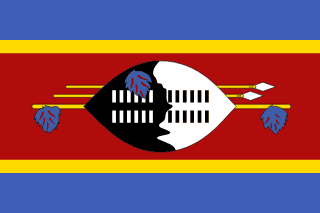
The flag of Eswatini is rectangular with an official proportion of 1:2 (length to width). It consists of three horizontal stripes: two thin blue stripes at the top and bottom, and a broad red stripe in the center, bordered by thin yellow lines above and below. Centered on the red stripe is a black-and-white Nguni-style shield adorned with black and white diagonal stripes radiating outward. Behind the shield are two spears and a staff decorated with feather tassels, which extend beyond the red stripe into the blue areas—this vivid depiction of weapons is rare among national flags.
Meaning
Red symbolizes the struggles and sacrifices made for survival and independence, blue stands for peace and stability, and yellow represents mineral wealth. The central Nguni shield and crossed spears come from a flag designed by King Sobhuza II for the Swazi Pioneer Corps in 1941, symbolizing traditional defense and the king’s role as guardian of the nation. The feather-tasseled staff represents royal dignity and traditional authority. The flag uniquely incorporates elements of national military heritage, making it highly distinctive.
History and Legal Status
The flag was adopted on Independence Day, September 6, 1968, based on a flag originally granted to the army in the 1940s, and has remained in use ever since. After the name change to Eswatini in 2018, the flag design was not altered and continues to represent the nation. The flag is prominently displayed on Independence Day (September 6), during parliamentary openings, at sporting events, and at overseas embassies and consulates. It is also permanently flown at the royal palace, government buildings, and border posts. During traditional ceremonies like the Reed Dance, the flag is displayed alongside royal insignia as part of the national symbolic ensemble.
Eswatini Travel Guide
All Guides »Swaziland Travel Quick Guide: Visa Transit, Safari Seasons, Budget & Cultural Taboos
How to plan a trip to the Kingdom of Eswatini via South Africa? Get the full run...
Classic 7-Day Eswatini Itinerary: A Highland Safari & Culture Loop Linked with Kruger 7 days
Enter and exit via Johannesburg, connecting the Hlane white rhino reserve, Mlilw...
Eswatini 4-Day Short Trip: Highlights of Ezulwini Valley Culture and Nature Reserves 4 days
A tight yet relaxed 1-day border crossing plus 3-day itinerary: covers cultural ...
Essential Attractions in Eswatini: Kingdom of White Rhinos and Royal Heritage
From elephant herds in Hlane to the Sibebe Rock monolith—discover 7 key highligh...
Eswatini Food Guide: Traditional Maize Porridge, Safari Camp Meals & Homemade Beer
What to Eat in the Kingdom? A Complete Guide to Swazi Traditional Dishes, Campfi...
Eswatini Travel Guide: Land Entry from South Africa, Border Options & Park Transfers
No Direct Flights? Here’s the Full Breakdown: Johannesburg Connections, Land Bor...
9 Practical Travel Tips for Eswatini
From malaria prevention and photography rules to packing glassware, these detail...