Cook Islands
An island nation comprising 15 islands in the South Pacific, in free association with New Zealand, known for the Rarotonga Ring Road, Aitutaki Lagoon, and Māori-Polynesian culture.
Cook Islands
| Capital | Avarua |
|---|---|
| Continent | Oceania |
| Languages | English, Cook Islands Māori |
| Currency | New Zealand Dollar (NZD NZ$) |
| Time Zone | UTC-10 (no daylight saving time) |
| Dialling Code | +682 |
| Area / Population | Approximately 236 square kilometers / Approximately 17,000 |
| Visa | Travelers can enter the Cook Islands visa-free for tourism stays of up to 31 days; longer stays may be extended, but visits exceeding six months require a visa applied for in advance through the Cook Islands Ministry of Foreign Affairs and Immigration. There are no direct flights from many countries; travelers usually transit via Auckland, New Zealand, and must also obtain a New Zealand NZeTA or transit/tourist visa. |
| Best Season | The dry season (local cool season) runs from May to October, with temperatures around 22–28°C, calm seas, and clear water—making it the best time to visit. April and September to October are less crowded and offer better prices. The rainy season and cyclone season lasts from November to April, so monitor weather conditions. |
| Main Cities | Rarotonga, Aitutaki, Atiu, Mangaia, Mitiaro, Manihiki, Avarua |
Cook Islands in Detail
Cook Islands Overview
The Cook Islands are located in the central South Pacific, part of Polynesia, about 3,000 kilometers northeast of New Zealand and southwest of Tahiti. The country consists of 15 islands divided into the Southern and Northern Groups, with a total land area of about 236 square kilometers scattered across nearly 2 million square kilometers of ocean. The capital, Avarua, is situated on the northern coast of the main island, Rarotonga, and serves as the political, economic, and transportation hub.
The Cook Islands are in free association with New Zealand, meaning they are self-governing in internal affairs. Since August 4, 1965, the islands have had their own constitution, parliament, and government, while New Zealand handles defense and foreign affairs. Residents are also New Zealand citizens, and the British monarch is the head of state, represented locally. The Cook Islands are not a UN member but participate independently in various international organizations and sporting events.
Geography and Climate
The 15 islands are grouped into two: the Southern Group consists mainly of volcanic islands with rugged terrain and fertile soil, including Rarotonga, Aitutaki, Atiu, Mangaia, Mauke, and Mitiaro. The Northern Group comprises mostly low-lying coral atolls, such as Manihiki, Rakahanga, Penrhyn, Pukapuka, and Nassau. Rarotonga is a volcanic island with a central ridge reaching about 650 meters, and the Ara Tapu Ring Road runs along the coastline for approximately 32 kilometers.
The islands have a tropical maritime climate, warm year-round with daytime temperatures typically between 22–28°C. The dry season (local cool season) from May to October brings steady trade winds, making it peak travel season. From November to April is the rainy season and cyclone season, with higher humidity and frequent showers. While the islands are suitable for swimming year-round due to their southern tropical location, sea conditions should be closely monitored during the rainy season.
Historical Background
Polynesian settlers arrived in the Cook Islands around the 6th to 10th centuries CE, voyaging from places like the Society Islands in canoes, forming Māori societies centered around family, villages, land, and sea. Spanish navigators first recorded the northern atolls in 1595, and British explorer Captain James Cook visited multiple times between 1773 and 1777, after whom the islands were later named.
In the 19th century, Christian missionaries transformed local beliefs and lifestyles. The islands became a British protectorate in 1888 and were annexed to New Zealand in 1901. In the mid-20th century, a growing desire for self-governance led to the adoption of a constitution on August 4, 1965, establishing the Cook Islands as a self-governing nation in free association with New Zealand. This date is still celebrated annually as Constitution Day.
Economy and Currency
Tourism is the backbone of the Cook Islands’ economy, contributing significantly to GDP directly and indirectly. Agriculture includes black pearls, citrus fruits, copra, and papaya, with black pearls from the northern islands of Manihiki and Penrhyn being especially renowned internationally. Other income sources include fishing, offshore financial services, remittances from overseas residents, and economic aid from New Zealand. Due to the remote location and limited resources, most consumer goods are imported, resulting in relatively high prices.
The official currency is the New Zealand Dollar (NZD), and the Cook Islands also issue their own Cook Islands Dollar coins at par value, both circulating equally. However, Cook Islands Dollars are only usable locally. The NZD is issued by the Reserve Bank of New Zealand, and since the Cook Islands have no independent monetary policy, prices and interest rates largely follow trends in New Zealand.
Culture and Society
Cook Islands culture is a typical representation of Māori-Polynesian heritage. The community is closely tied to family and villages, with strong emphasis on land, sea, and tradition. Tivaevae (quilted patchwork) is considered a treasured female craft, while wood and stone carving often depict mythological ancestors and the sea god Tangaroa. Pareu fabrics, woven hats, and canoes (vaka) also hold cultural significance.
Drumming and dancing are central to festivals. The annual Te Maeva Nui Cultural Festival in late July to early August features performances and competitions from all islands, centered in Rarotonga, offering an ideal opportunity to experience local traditions. Most residents are Christian, and Sunday church services and family gatherings are important—visitors should respect village customs and religious observances.
Tourism Overview
The Cook Islands are one of the South Pacific’s most popular holiday destinations. The main island, Rarotonga, is great for self-drive tours and laid-back living, with Muri Lagoon ideal for snorkeling and kayaking. Aitutaki, an outer island, boasts one of the world’s most beautiful lagoons, with One Foot Island as a highlight. Atiu is known for its unique kopeka birds and limestone caves, while Mangaia is one of the oldest islands in the Pacific.
It’s also a great spot for diving and stargazing, with coral reefs and shipwrecks underwater, and black pearl farms in the northern atolls. The dry season from April to October is peak tourist time, perfect for honeymoons, diving, and immersive island experiences. Inter-island flights are operated by Air Rarotonga, connecting Rarotonga with islands like Aitutaki.
Local Currency: New Zealand Dollar (NZD)
Currency Overview
The official currency of the Cook Islands is the New Zealand Dollar (currency code NZD, symbol NZ$), issued by the Reserve Bank of New Zealand. As the Cook Islands are in free association with New Zealand and lack an independent central bank, the NZD is the sole legal tender. The Cook Islands also issue their own Cook Islands Dollar coins at par with the NZD, both circulating together, though Cook Islands Dollars are only valid locally.
Historically, the Cook Islands Dollar included both notes and coins. After the 1995 financial crisis, most Cook Islands Dollar banknotes (except the NZ$3 note) were phased out, and NZD banknotes became the main currency for transactions. Locally minted Cook Islands Dollar coins, however, remain in circulation and are valued for both practical use and as souvenirs.
Denominations
New Zealand Dollar banknotes come in denominations of NZ$5, NZ$10, NZ$20, NZ$50, and NZ$100, printed on polymer and featuring vibrant colors and strong security features. Coins are available in 10¢, 20¢, 50¢, NZ$1, and NZ$2. The Cook Islands also issue their own coins in denominations of 10¢, 20¢, 50¢, NZ$1, NZ$2, and NZ$5. Notably, the NZ$2 coin is triangular—one of the first triangular coins in global circulation—and the NZ$5 coin is dodecagonal (12-sided), giving it a distinctive shape. A former NZ$3 banknote is now mostly a collector’s item.
Cook Islands coins typically feature the British monarch on the obverse and local flora, marine life, or traditional items on the reverse, each with unique designs. Their similar size and material to New Zealand coins allow the two coin types to be used interchangeably in practice.
Cash and Payment Habits
Cash is still widely used in the Cook Islands, especially in restaurants, markets, taxis, and shops on outer islands. There are a few ATMs on Rarotonga and two on Aitutaki, but none on the other islands, so bring enough cash before visiting outer islands. Hotels, resorts, car rental companies, and larger restaurants generally accept international credit cards like Visa and Mastercard, but mobile payments are not common.
It’s advisable to carry sufficient New Zealand Dollar cash and exchange or withdraw money in Auckland during transit. Imported goods, especially milk and fuel, can be expensive, so compare prices before shopping. Be aware of potential foreign transaction fees when using credit cards.
Traveler Tips
- Cook Islands Dollars are only valid locally—exchange back to NZD before leaving.
- There are no ATMs on outer islands, so bring enough NZD cash in advance.
- NZ$3 banknotes and some older coins are no longer in circulation—these can be found at coin dealers or collectors' markets.
- Tipping is not customary—the bill amount is final.
Flag Meaning
Flag Design
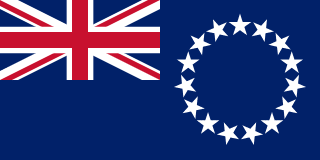
The Cook Islands flag follows the Blue Ensign design: a dark blue field in a 1:2 ratio, with the Union Jack in the canton (top left), occupying half the height and half the width of the flag. On the fly side (right), there is a ring of 15 white five-pointed stars. Each star is of equal size, arranged in a circle without additional symbols, creating a clean and instantly recognizable design of blue background and white star ring.
Meaning
The deep blue represents the Pacific Ocean surrounding the islands, as well as peace and tranquility. The Union Jack in the canton reflects the historical ties to Britain and the Cook Islands’ status as a member of the Commonwealth. The 15 white stars symbolize the 15 islands of the Cook Islands, arranged in a circle to signify unity and their shared placement within the surrounding ocean. The overall design emphasizes the close relationship between the island nation and the sea.
History and Legal Status
After gaining self-government in 1965, the Cook Islands initially used a green flag featuring a ring of 15 golden stars. On August 4, 1979, the current Blue Ensign design with the Union Jack and star ring was officially adopted and has been in use ever since. As a self-governing nation in free association with New Zealand, the Cook Islands has its own national symbols, and the flag is displayed alongside the New Zealand flag on Constitution Day, at sporting events, and in international settings. Local laws regulate the proper use of the flag, prohibiting the addition of any text or markings.
Cook Islands Travel Guide
All Guides »Quick Guide to Traveling to the Cook Islands: Visa-Free Entry, Best Time to Visit, Budget & Local Etiquette
Get everything in one go — visa-free entry, transit visas, peak travel seasons, ...
Classic 7-Day Cook Islands Itinerary: Rarotonga Loop and Aitutaki Lagoon Island-Hopping 7 days
A mix of slow life on the main island and the most stunning lagoon on outer isla...
Cook Islands 4-Day Short Trip: In-Depth Exploration of Rarotonga 4 Days
Limited time? Focus on the main island: break it into sections—west coast, south...
Must-visit attractions in the Cook Islands: from Muri Lagoon to One Foot Island on Aitutaki
Organized by main island, outer islands, and other islands, each entry includes ...
Cook Islands Food Guide: Ika Mata, Earth Oven Feasts & Seafood
From coconut milk-marinated raw fish to earth-oven-baked taro, sample the tradit...
Cook Islands Transport Guide: Inter-island Flights, Island Buses, and Car Rentals
From connecting flights via Auckland to island-hopping and island-circling route...
10 Practical Tips for Traveling to the Cook Islands
From visas and layovers to cash access on outer islands and protecting coral ree...