Cambodia
A Southeast Asian ancient civilization known for the Angkor Wat temple complex, Theravāda Buddhist culture, and the unique monetary system where the US dollar and the riel coexist. The country features low prices and convenient visa policies.
Cambodia (Kingdom of Cambodia)
| Capital | Phnom Penh |
|---|---|
| Continent | Asia |
| Languages | Khmer |
| Currency | Riel (KHR ៛) |
| Time Zone | UTC+7 |
| Dialling Code | +855 |
| Area / Population | Approximately 181,000 square kilometers / Approximately 17 million |
| Visa | Most foreign visitors can apply for an e-Visa to Cambodia (costing approximately 36 USD), or obtain a visa on arrival at designated ports, typically for a 30-day stay. Required documents include a passport, photo, and visa fee. Policies may change, so check the latest regulations with the country's embassy or consulate in your own country before traveling. |
| Best Season | The cool season from November to February is dry and comfortable, making it the best time to visit Angkor and Phnom Penh. March and April are hot, while the rainy season from May to October sees afternoon showers but fewer tourists and lower prices. |
| Main Cities | Siem Reap, Phnom Penh, Sihanoukville, Kampot, Kep, Battambang, Kampong Thom, Tonlé Sap Lake |
Cambodia in Detail
Overview of Cambodia
Cambodia (officially the Kingdom of Cambodia) is located in the southern part of the Indochinese Peninsula in Southeast Asia. It borders Thailand to the west, Laos to the north, Vietnam to the east and southeast, and the Gulf of Thailand to the southwest. The country covers an area of about 181,000 square kilometers, with its capital, Phnom Penh, situated at the confluence of the Mekong, Tonlé Sap, and Bassac rivers. Phnom Penh serves as the national political, economic, and transportation hub. The population is around 17 million, with the Khmer ethnic group making up about 90%, alongside Cham, Chinese, Vietnamese, and various hill tribes. Cambodia is a constitutional monarchy, with the king as the head of state, while the parliament and government hold executive power. It is traditionally an agricultural nation and one of the oldest countries in Southeast Asia.
As a UNESCO World Heritage site, the Angkor temples attract millions of international tourists annually. Tourism, along with garment exports and construction, forms the three pillars of the national economy.
Geography and Climate
Cambodia’s terrain features the Mekong and Tonlé Sap alluvial plains in the central region, highlands in the east, and the Cardamom and Elephant Mountains in the west and southwest. The Dângrêk Mountains run along the northern border with Thailand. Tonlé Sap Lake, the largest freshwater lake in Southeast Asia, can expand several times its size during the rainy season and is a vital fishing resource. The floating villages and sunset views on the lake offer unique travel experiences. The Mekong River flows from north to south, serving as a lifeline for agriculture and transportation.
The climate is tropical monsoon, with high temperatures year-round. It is divided into a rainy season (May to October) and a dry season (November to April). The dry season is further split into a cool season (November to February, the most comfortable) and a hot season (March to April, with temperatures approaching 40°C). The best travel period is from November to February, when the skies are clear, and the lighting is ideal for photographing sunrise and sunset at Angkor.
Historical Background
Cambodia is an ancient Southeast Asian civilization. Influenced by Indian culture from the 1st century, the Funan Kingdom was established, followed by the Chenla Kingdom in the 6th century. The Angkor Empire rose in the 9th century, with King Suryavarman II constructing Angkor Wat in the 12th century and King Jayavarman VII building Bayon Temple and Angkor Thom. Angkor once became one of the largest cities in the world. After the Siamese captured Angkor in 1431, the capital moved south to Phnom Penh, and the kingdom gradually declined. Cambodia became a French protectorate in 1863, regained independence in 1953 under King Norodom Sihanouk, who reigned until 1970.
From 1975 to 1979, the Khmer Rouge regime caused the deaths of an estimated 1.7 to 2 million people, about a quarter of the population at the time. The Tuol Sleng Genocide Museum and the Choeung Ek Killing Fields remain important memorial sites. After 1979, the country underwent reconstruction. In 1993, elections were held under UN supervision, restoring the constitutional monarchy, with Sihanouk returning as king. His son, Norodom Sihamoni, succeeded him in 2004.
Economy and Currency
Cambodia is an emerging economy in Southeast Asia, with its key sectors including garment and footwear exports, construction, tourism, and agriculture. While the economy has maintained relatively fast growth in recent years, per capita income remains low, and urban-rural disparities are significant. The official currency is the Cambodian riel (KHR, symbol ៛), issued by the National Bank of Cambodia. Due to historical conflicts and inflation, the US dollar is widely used in Cambodia, circulating almost equally with the riel. Major transactions are typically priced and settled in dollars, with the exchange rate at approximately 1 USD to 4,000 KHR. The riel is mainly used for small change. Siem Reap is the main tourist hub, while Phnom Penh serves as the business and financial center.
Culture and Society
Cambodian culture is predominantly Khmer, with about 95% of the population practicing Theravāda Buddhism. Monks hold a revered status, and temples are found throughout urban and rural areas. It is common for men to become monks for short periods during their lives. Traditional clothing, classical Apsara dance, shadow puppetry, and Khmer martial arts reflect strong Indian cultural influences. The pace of life is slow, and the traditional greeting is the sampeah (placing palms together in a prayer-like gesture). Public respect is expected for monks, Buddha statues, and the royal family.
The cuisine primarily features rice, freshwater fish, coconut milk, and spices. It is milder than Thai food, lacking the intense sourness and spiciness. Popular dishes include Amok, Cambodian red curry, Lok Lak (stir-fried beef), and noodle soups. Due to French colonial influence, baguettes and drip coffee are also part of daily life.
Tourism Overview
Cambodia is world-renowned for the Angkor temples. Highlights include the sunrise at Angkor Wat (Angkor Vat), the smiling Bayon faces, the tree-covered Ta Prohm, and the intricately carved Banteay Srei. Siem Reap serves as the base for exploring Angkor. Phnom Penh features the Royal Palace, Silver Pagoda, National Museum, and museums documenting the Khmer Rouge era, such as the Tuol Sleng Genocide Museum and Choeung Ek Killing Fields. Coastal cities like Sihanoukville, Kampot, and Kep have emerged as popular beach destinations in recent years, while the floating villages on Tonlé Sap Lake showcase a unique way of life. With its low prices and convenient visas, Cambodia is an excellent choice as a cultural highlight in any Southeast Asia trip.
Local Currency: Riel (KHR)
Currency Overview
The official currency of Cambodia is the riel (currency code KHR, symbol ៛), issued by the National Bank of Cambodia. One riel is divided into 100 sen, though sen coins are no longer in circulation due to long-term inflation. The most unique aspect of Cambodia’s currency system is the parallel use of the US dollar and the riel. Owing to historical instability and currency devaluation, the US dollar has been widely trusted since the 1990s and is used almost interchangeably with the riel. Hotels, airfares, restaurants, and shops typically price and settle transactions in dollars, while the riel is mainly used for small change. This dual-currency system is unique in Southeast Asia and is an important local custom for travelers to adapt to.
Denominations
Riel banknotes come in denominations of 100, 200, 500, 1,000, 2,000, 5,000, 10,000, 20,000, 50,000, and 100,000 riel. The most commonly used notes are between 1,000 and 20,000 riel. The front typically features a portrait of King Norodom Sihamoni, while the back showcases Angkor temple reliefs and historical scenes in vibrant colors, making them easy to recognize.
The most frequently used US dollar bills are 1, 5, and 10 USD. Fifty and 100 USD bills are less practical due to difficulty in getting change and the risk of being rejected if old or damaged, so it’s best to avoid carrying them. The fixed exchange rate is approximately 1 USD to 4,000 KHR. When receiving change, it’s common to get a mix of dollars and riel—for example, a 1.5 USD purchase might be given 2,000 KHR in change. This is normal practice and nothing to worry about.
Cash and Payment Habits
Cambodia is a highly cash-dependent society. Small restaurants, markets, tuk-tuks, and rural areas typically only accept cash. Hotels, supermarkets, and some restaurants in Phnom Penh and Siem Reap accept Visa, Mastercard, and UnionPay. Local digital payment methods like ABA Pay, Wing, and KHQR codes are becoming more common in cities but remain less accessible for foreign travelers, so cash is still the primary option for now.
ATMs are widespread in Phnom Penh, Siem Reap, and Sihanoukville, and most dispense US dollars. A typical transaction fee is around 4–5 USD, with common single withdrawal limits of 200–500 USD. To reduce fees, it’s advisable to withdraw larger amounts at once. Currency exchange can be done at banks, airports, and gold shops. Gold shops in Siem Reap and Phnom Penh often offer better rates. Always count your money and check for damage when exchanging. In Phnom Penh and Siem Reap, some businesses accept both dollars and riel and may automatically convert prices. Before paying, confirm the currency used and how change will be given to avoid misunderstandings.
Tips for Travelers
- Carry small-denomination bills like 1, 5, and 10 USD, as many small shops struggle to provide change for 20 USD or higher.
- Damaged, marked, or old US dollar bills are often refused—always ensure your bills are clean and intact.
- Receiving riel in change is common, so familiarize yourself with the 1,000 and 5,000 riel notes to avoid accidentally spending larger denominations.
- Use dollars for large purchases and riel for small change—that’s the most natural and practical approach locally.
- Mixed use of riel and dollars is standard, so always double-check the currency of your change to avoid confusion.
Flag Meaning
Flag Design
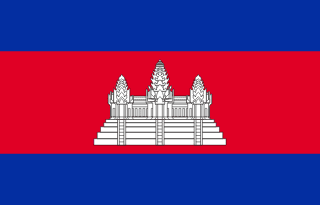
The Cambodian flag consists of three horizontal stripes: blue at the top and bottom, and red in the middle. The red stripe is twice the width of each blue stripe, with an overall ratio of 2:3. At the center of the red stripe is a white depiction of the Angkor Wat temple, occupying about one-third of the flag’s height and centered within the red band. The design is symmetrical and highly recognizable even from a distance.
The blue is a deep navy, the red is a pure crimson, and the white Angkor Wat outline uses simple lines to capture the three towers and base of the temple, ensuring visibility while retaining the iconic features of the monument.
Meaning
Blue symbolizes the monarchy, the nation, and freedom, while red represents the country and its people, as well as the courage to fight for the nation. The white Angkor Wat signifies Buddhism, justice, and the nation’s cultural heritage. As Cambodia’s most important national symbol, placing Angkor Wat at the center of the flag reflects the country’s foundation in ancient civilization and the central role of Buddhism in daily life.
The combination of these three colors and the architectural motif unites royalty, nationhood, and religion in a single emblem, making the flag a powerful representation of Cambodian national identity.
History and Legal Status
The Cambodian flag has been in use since the eve of independence in 1948, though it has undergone several changes. During the 1970 coup, the Khmer Rouge era (1975–1979), and the 1979–1989 period, the design was altered, and the Angkor Wat image was at times removed. After the restoration of the constitutional monarchy in 1993, the original 1948 tricolor flag featuring Angkor Wat was reinstated and remains in use today.
The Cambodian flag is one of the very few in the world to feature a building, and the only one with Angkor Wat as its central motif. Amidst flags dominated by stripes and symbols, this design stands out for its distinctive central monument. The flag is highly respected domestically, with clear guidelines for its proper display and use in public settings.
Cambodia Travel Guide
All Guides »Cambodia Solo Travel Quick Guide: Visa, Best Season, Budget & Temple Etiquette Essentials
Whether to get a visa on arrival or an e-visa, when is the best time to see Angk...
7-day Classic Route in Cambodia: Siem Reap Angkor, Phnom Penh & Southern Beaches Itinerary 7 days
Experience Cambodia’s ancient ruins, urban charm, and coastal relaxation in one ...
4-Day Short Trip Itinerary in Cambodia: In-Depth Tour of Angkor’s Small, Big, and Grand Circuits plus Tonlé Sap Lake 4 Days
Dedicating all 4 days to Siem Reap and organizing your visit around the Small Ci...
Complete list of must-visit attractions in Cambodia: Angkor Archaeological Park, Royal Palace in Phnom Penh, and southern coastal scenery
From Angkor Wat to the Royal Palace in Phnom Penh, from Tonlé Sap Lake to Kampot...
The Ultimate Guide to Cambodian Cuisine: Amok, Cambodian Red Curry, and French-Inspired Street Food
Mild-flavored Cambodian cuisine is infused with influences from the French colon...
The Ultimate Guide to Transportation in Cambodia: Tuk-Tuks, Angkor Tours, and Intercity Buses
In Cambodia, how to negotiate tuk-tuk fares, how much a one-day Angkor tour cost...
10 Essential Travel Tips for Cambodia: Dollar Bills, Angkor Tickets & Avoiding Scams
From small-denomination U.S. dollars and torn bills being rejected, to temple dr...