Bosnia and Herzegovina
Where Eastern and Western cultures meet, this destination is famed for Sarajevo’s Latin Bridge, the Baščaršija Old Town, Mostar’s Stari Most bridge, and its unique spirit of religious coexistence.
Bosnia and Herzegovina
| Capital | Sarajevo |
|---|---|
| Continent | Europe |
| Languages | Bosnian, Serbian, Croatian |
| Currency | Bosnia and Herzegovina convertible mark (BAM KM) |
| Time Zone | UTC+1 (7 hours in winter) |
| Dialling Code | +387 |
| Area / Population | 51,209 square kilometres / Approximately 3.2 million |
| Visa | Bosnia and Herzegovina and several other countries have a mutual visa exemption agreement: most foreign visitors can enter, exit, stay, or transit for up to 90 days within any 180-day period without a visa by presenting their passport and a return ticket. |
| Best Season | The best times for city sightseeing and hiking are April–June and September–October; Mostar is hot but most eventful in July–August; skiing is available around Sarajevo from December–March. |
| Main Cities | Sarajevo, Mostar, Banja Luka, Jajce, Travnik, Tuzla, Bihać, Neum |
Bosnia and Herzegovina in Detail
About Bosnia and Herzegovina
Bosnia and Herzegovina (abbreviated as BiH) is located in the central and western parts of the Balkan Peninsula. It borders Serbia to the north and east, Montenegro to the south, and Croatia to the west and northwest. It has a short stretch of about 20 kilometres of Adriatic Sea coastline near Neum. The country covers an area of approximately 51,209 square kilometres, with a population of around 3.2 million. Its capital, Sarajevo, hosted the 1984 Winter Olympics and was also where the assassination that triggered World War I took place in 1914. It is known as the "city where East meets West."
Bosnia and Herzegovina has a politically unique structure in Europe. According to the 1995 Dayton Agreement, the country consists of two entities: the Federation of Bosnia and Herzegovina (also called the Bosniak-Croat Federation) and the Republika Srpska, with the Brčko District holding a special status. The presidency is a three-member body, with one representative each from the Bosniak, Serb, and Croat communities taking turns as chair. The name "Bosnia" comes from the Bosna River, while "Herzegovina" refers to the medieval territory of a duke (Herceg).
Geography and Climate
The Dinaric Alps run diagonally across Bosnia and Herzegovina from the northwest to the southeast, covering over 80% of the country with mountains and plateaus. The highest peak, Maglić Mountain (2,386 metres), lies on the border with Montenegro. The Neretva River cuts through deep valleys to reach Mostar, while the Una, Vrbas, and Bosna rivers nourish various river valleys. Waterfalls, canyons, and rapids make the region a popular destination in Europe for rafting and canyoning. The northern part along the Sava River features fertile plains, while southern Herzegovina is drier and rockier, transitioning into a Mediterranean climate zone.
The climate is distinctly zoned: the Sarajevo area has a mild continental climate, with hot summers and snowy winters (which is why it was chosen to host the 1984 Winter Olympics); Mostar in Herzegovina has a Mediterranean climate, with temperatures often exceeding 35°C in July; the central valleys around Jajce and Travnik enjoy the most pleasant springs and autumns. Around October, the mountains turn into a riot of autumn colours, making it a golden season for photography and hiking.
Historical Background
Ancient Bosnia was home to the Illyrians and later part of the Roman Empire’s Dalmatian provinces. In the 7th century, Slavs settled here, and by the late 12th century, the Banate of Bosnia was established. During the era of Ban Kulin in the late 12th century, trade flourished. The country is home to around 60,000 medieval tombstones known as stećci, which have been collectively inscribed as a UNESCO World Heritage Site. In 1463, the Ottoman Empire conquered Bosnia, ruling for over 400 years. Sarajevo was founded in the mid-15th century, and the copper-smith street, mosques, and caravanserais in the Baščaršija Old Town date from this period, with Islamic culture taking deep root.
After the 1878 Berlin Conference, the Austro-Hungarian Empire occupied Bosnia, formally annexing it in 1898. The Moorish Revival architecture in areas like the Latin Quarter and the National Library (Vijećnica) dates from this time. On June 28, 1914, Gavrilo Princip assassinated Archduke Franz Ferdinand on Sarajevo’s Latin Bridge, sparking World War I. After the war, Bosnia became part of Yugoslavia and later one of the socialist republics within the federation, hosting the 1984 Winter Olympics. In March 1992, Bosnia declared independence following a referendum, leading to a three-and-a-half-year war, during which Sarajevo was under siege for nearly four years. The Dayton Agreement was signed in November 1995, establishing the current federal structure.
Economy and Currency
Bosnia and Herzegovina is an upper-middle-income developing economy. Key industries include aluminium and metal processing, energy (hydropower and thermal power), auto parts, wood processing, and a rapidly growing tourism sector—Mostar and Sarajevo have repeatedly appeared on lists of Europe’s most affordable destinations in recent years. The official currency is the Bosnia and Herzegovina convertible mark (currency code BAM, symbol KM), issued by the Central Bank of Bosnia and Herzegovina. Since 1998, the mark has been pegged to the euro at a fixed rate of 1 euro = 1.95583 marks, making the exchange rate extremely stable and a reliable anchor for understanding the local economy. Remittances and exports—especially of metals and timber to the EU—are key sources of foreign currency.
Culture and Society
Bosnia and Herzegovina is made up of three main ethnic groups: Bosniaks (mostly Muslim), Serbs (Eastern Orthodox), and Croats (Catholic). All three groups speak mutually intelligible forms of the same language, referred to respectively as Bosnian, Serbian, and Croatian. In Sarajevo’s Old Town, mosques, Orthodox churches, Catholic churches, and synagogues stand side by side within a few hundred metres. The phrase "where East meets West" is not just a slogan but a daily street scene; the call to prayer and church bells often ring out simultaneously, creating one of the city’s most moving soundscapes. In terms of food, Ottoman legacy dishes like ćevapi (grilled minced meat served with soft somun bread), Bosnian coffee, and various types of pita pies are shared by all.
Tourism Overview
Bosnia and Herzegovina offers mature and highly affordable tourism experiences. Sarajevo’s Baščaršija, Latin Bridge, and the wartime "Tunnel of Hope" tell the layered history of the city. At Mostar’s iconic Stari Most bridge (a UNESCO World Heritage Site since 2005), generations of young people have leapt into the Neretva River from the bridge’s centre—a diving tradition that has lasted for centuries. Highlights on shorter routes include the Blagaj Tekke monastery spring, Počitelj stone town, Kravice Waterfall, and the waterfalls within Jajce. Land entry from Dubrovnik in Croatia or Belgrade in Serbia is convenient, making it an essential stop on the Balkan travel circuit.
Local Currency: Bosnia and Herzegovina convertible mark (BAM)
Currency Overview
The official currency of Bosnia and Herzegovina is the Bosnia and Herzegovina convertible mark (currency code BAM, symbol KM), issued by the Central Bank of Bosnia and Herzegovina. One convertible mark equals 100 fening. Since its introduction in 1998, the mark has been tightly pegged to the German mark and subsequently to the euro at a fixed rate of 1 euro = 1.95583 marks. This rate has remained unchanged for over 20 years. The currency system operates under a currency board arrangement, meaning the central bank does not have independent monetary policy authority. This makes Bosnia and Herzegovina one of the countries in Europe with the most predictable exchange rates, and travellers need not worry about currency fluctuations.
Denominations
Banknotes come in denominations of 10, 20, 50, 100, and 200 marks, while coins are issued in 5, 10, 20, 50 fening, and 1, 2 marks (coins of 1, 2, and 5 fening are becoming increasingly rare). An interesting detail: due to the division between the Federation and the Republika Srpska, banknotes of 10, 20, 100, and 200 marks exist in two designs—one featuring landmarks from cities like Sarajevo, and the other featuring cities and figures from the Republika Srpska. Both sets share the same denominations, are equal in value, and circulate nationwide, being accepted at any cash register. Noticing the differences between these notes can be a small hobby for collectors.
Cash and Payment Habits
Restaurants, supermarkets, and hotels in Sarajevo and Mostar generally accept Visa/Mastercard, and ATMs are widely available. However, small shops in the Baščaršija copper-smith street, taxis, intercity buses, and rural restaurants still primarily deal in cash. It is advisable to carry 30–50 marks in cash per person per day. When crossing borders: if entering from Dubrovnik in Croatia for a day trip, some vendors at tourist spots may quote prices in euros, but change will still be given in marks. Dollars and euros can be exchanged at formal banks, but exchange offices (mjenjačnica) generally offer competitive rates, and small foreign currency exchanges are simple to process. Credit card payments at supermarkets (such as Konzum and Bingo) usually have no minimum spending requirements.
Traveller Tips
- To roughly convert prices: divide the mark amount by 2 and add about 2% to get the equivalent in euros—1 euro is approximately 1.96 marks.
- Marks are only legal tender within Bosnia and Herzegovina. Use up any leftover small change in supermarkets or cafés before leaving, as they are rarely exchangeable abroad.
- Taxis, buses, and street food vendors only accept cash. It’s wise to carry 10/20 mark notes.
- Banknotes issued by the two entities have different designs but are equally valid. Cashiers will not refuse either, so there’s no need to exchange them deliberately.
Flag Meaning
Flag Design
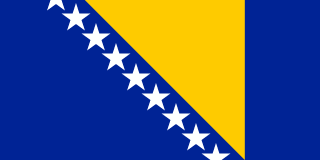
The flag of Bosnia and Herzegovina is a rectangular field of medium blue with a 1:2 aspect ratio. Along the hoist side is a yellow right-angled triangle, with its perpendicular and base sides aligned vertically and horizontally with the flag edges, and its hypotenuse facing outward. Nine white five-pointed stars are arranged along the hypotenuse from top to bottom, with the top and bottom stars cut off halfway by the flag edges, leaving seven full stars visible. The combination of the yellow triangle and white stars against the deep blue background is one of the most modern-looking national flags currently in use in Europe.
Meaning
The blue background and white star cluster symbolise Europe and the United Nations, reflecting Bosnia and Herzegovina’s aspiration to join the European family. The yellow triangle is commonly interpreted as representing the country’s triangular shape, as well as symbolising its three main ethnic groups—the Bosniaks, Serbs, and Croats—interdependent and essential to one another. The stars extending beyond the triangle’s edges signify the nation’s future and infinite continuity.
History and Legal Status
The current flag was adopted on February 4, 1998, following an international design competition overseen by the then-High Representative. It replaced the 1992–1998 flag, which had a white background with golden lilies—a design with strong Bosniak symbolism that was not accepted by the other two ethnic groups. The new flag deliberately avoids any single ethnic religious or historical emblem, using only neutral geometric and stellar elements, thus becoming a product of multi-ethnic compromise. In 2001, the Bosnian parliament passed a flag law standardising colour specifications (blue, yellow, and white, all defined by Pantone codes) and rules for display.
Today, the Bosnian flag is used at government buildings, military and police units, border crossings, and international events. In the Republika Srpska, the Serbian flag is often displayed alongside the Bosnian flag at official events. Similar to Kosovo, the use of flags reflects the complex political realities of the country.
Bosnia and Herzegovina Travel Guide
All Guides »Bosnia and Herzegovina Travel Preview: Visa-Free Policy, Best Seasons, Budget, and Multi-Ethnic Etiquette Guide
A European destination reachable visa-free for 90 days: Before you go, understan...
Classic 7-day Bosnia and Herzegovina itinerary: Sarajevo – Jajce – Mostar – Kravice Waterfall 7 days
A single route covering the meeting point of Eastern and Western cultures: Olymp...
Bosnia and Herzegovina 4-Day Short Trip: Two Days in Sarajevo + Two Days at Mostar’s Old Bridge 4 days
With just four days, focus on two cities: spend two days exploring the layered h...
Must-Visit Attractions in Bosnia and Herzegovina: 16 Highlights Including Old Bridge Diving, Latin Bridge, and the City’s Waterfall
From Sarajevo’s historic landmarks and Mostar’s iconic bridge diving to northern...
Bosnia and Herzegovina Food Guide: How to Eat Ćevapi, Bosnian Coffee, and Ottoman Sweets
The Bosnian dining table is a blend of Ottoman and Central European influences: ...
Travel Guide to Transportation in Bosnia and Herzegovina: Sarajevo Airport, Intercity Buses, and Scenic Trains
How to get around after visa-free entry? A complete guide to reaching Sarajevo c...
Practical Tips for Traveling in Bosnia and Herzegovina: 10 Insights on Visa-Free Entry, Marka Cash, and Old Bridge Safety
From the 90-day visa-free policy, cash habits using the Bosnia and Herzegovina m...