Angola
A Portuguese-speaking African nation bordering the Atlantic Ocean, where the Luanda Bay, the Calandula Waterfalls, and the edge of the Namib Desert hide some of Africa’s most underexplored landscapes.
Angola (Republic of Angola)
| Capital | Luanda |
|---|---|
| Continent | Africa |
| Languages | Portuguese |
| Currency | Angolan Kwanza (AOA Kz) |
| Time Zone | UTC+1 |
| Dialling Code | +244 |
| Area / Population | 1,246,700 square kilometers / Approximately 36 million |
| Visa | Most foreign visitors need a visa to enter Angola. Tourist visas can be applied for online via Angola’s official e-visa platform or through Angolan embassies or consulates. You will need to provide a hotel booking, return flight tickets, and proof of yellow fever vaccination. Confirm the latest entry requirements before departure. |
| Best Season | The dry season from May to October is the best time to visit, with cool and less rainy weather in Luanda. Southern areas near the Namib Desert and the Lubango Plateau have the most stable weather from June to August. From November onward, the rainy season brings humidity to the coast and road blockages inland. |
| Main Cities | Luanda, Benguela, Lobito, Huambo, Malanje, Lubango, Namibe, Soyo |
Angola in Detail
Overview of Angola
Angola (officially the Republic of Angola) is located in southwestern Africa, bordered by the Atlantic Ocean to the west, the Democratic Republic of the Congo and the Republic of the Congo to the north, Zambia to the east, and Namibia to the south. It has a coastline of about 1,600 kilometers and covers an area of approximately 1.247 million square kilometers, making it the seventh-largest country in Africa. Its capital, Luanda, sits on a crescent-shaped bay and is one of the most populous Portuguese-speaking cities in sub-Saharan Africa. The country has a population of around 36 million, with Portuguese as the official language. Local Bantu languages such as Umbundu, Kimbundu, and Kikongo are also widely spoken.
On November 11, 1975, Angola declared independence from Portuguese colonial rule and became the largest Portuguese-speaking country in Africa, as well as a key member of the Community of Portuguese Language Countries. After a long civil war and post-2002 reconstruction, Angola has emerged as an important economy in sub-Saharan Africa, driven by oil and diamonds.
Geography and Climate
Angola’s terrain rises from the Atlantic coast inland: the northern coastal region consists of tropical wet plains, while the central Bié Plateau rises over a thousand meters above sea level and is the source of the Cuanza and Cubango Rivers (one of the sources of the Okavango River). The highest peak, Mount Moco, stands at 2,620 meters. The southwestern region gradually transitions into the Namib Desert section of Angola, with the barren and dramatic desert coastline of Namibe Province. The Tunda Vala fissure on the edge of the Lubango Plateau offers breathtaking views of rugged gorges, while the Calandula Waterfalls in Malanje plunge about 105 meters with a width of up to 400 meters, ranking as the second-largest waterfalls in Africa.
The cold Benguela Current flows northward along the coast, contributing to the arid and low-rainfall conditions of the southern coast and creating world-class fishing grounds. The northern part has a tropical savanna climate, with the rainy season from October to April and the dry season from May to September. Luanda, moderated by the cold current, experiences frequent cloud cover and cooler temperatures during the dry season.
Historical Background
During the medieval period, Angola was home to kingdoms such as the Kingdom of Kongo and the Kingdom of Ndongo. The title “Ngola” of the Ndongo Kingdom is the origin of the country’s name “Angola.” The legendary story of Queen Nzinga resisting Portuguese colonization remains widely known. In 1483, Portuguese navigator Diogo Cão arrived at the mouth of the Congo River, and Luanda was founded in 1575. For the next three centuries, it became one of the largest export hubs for the transatlantic slave trade. By the mid-20th century, coffee and diamonds had driven the colonial economy, setting the stage for the independence movement.
After gaining independence in 1975, Angola plunged into nearly 27 years of civil war, which ended in 2002. Since then, oil revenues have driven large-scale reconstruction: skyscrapers and coastal boulevards have risen in Luanda, roads and railways have been gradually restored to connect the east and west, and the Benguela Railway has been extended to the borders of the Democratic Republic of the Congo and Zambia, reopening access to the Atlantic.
Economy and Currency
Angola is one of Africa’s second-largest oil producers, with petroleum dominating export revenues. It also holds significant diamond reserves, with offshore oil blocks spread across the edges of the Congo Basin. Fishing, supported by the Benguela Current, is an important source of protein and export revenue. Agriculture, once a major export sector before the war, is now in recovery. The national currency is the kwanza (AOA), named after the Cuanza River that runs across the country. Luanda, with its large expatriate executive and technical population, has long ranked among the world’s most expensive cities for expatriates. Hotel, dining, and rental prices can be shocking for first-time visitors, so travel budgets should be planned for a high-cost emerging economy city.
Culture and Society
Angolan culture is a blend of African traditions and Portuguese heritage. With Portuguese as a bridge, Semba dance is considered one of the origins of Samba, and popular music genres like Kizomba and Kuduro have swept the Lusophone world. The Luanda Carnival in February is a nationwide celebration, featuring Samba-style parades and drumming throughout the night. In terms of cuisine, cassava porridge “funge” with stewed dishes “calulu,” chicken muamba, and grilled grouper or lobster from seaside stalls showcase both inland and coastal flavors. Urban youth culture is vibrant, with Luanda’s street art, fashion, and music festivals gaining influence across Africa.
Tourism Overview
Angola is a true “wilderness-level” destination on the African tourism map. The Marginal coastal boulevard in Luanda connects colonial-era Fort São Miguel, the Iron Palace, and a skyline of skyscrapers, while the sunset and seafood at Ilha do Cabo beach offer highlights for urban travelers. Kissama National Park, just two hours from the capital, is a window into Africa’s wildlife reintroduction projects. The Black Stones mountains and Calandula Waterfalls in the direction of Malanje, the Tunda Vala Canyon and Leba Pass in Lubango, the Namibe Desert and Arco rock formation create a north-south deep travel route. Tourism infrastructure is still developing, so it’s advisable to hire a car with a local driver-guide throughout the trip. Knowing some Portuguese or bringing a translation tool will greatly smooth your journey.
Local Currency: Angolan Kwanza (AOA)
Currency Overview
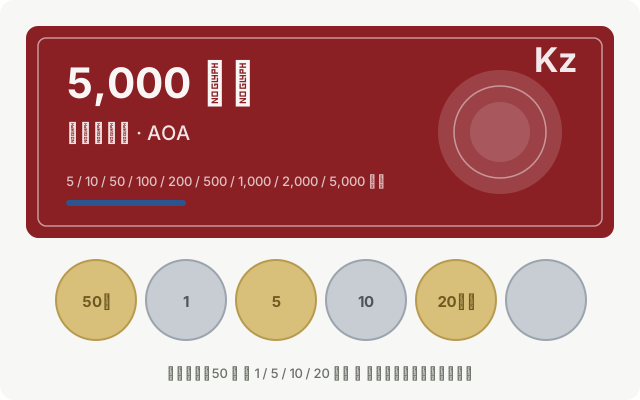
The official currency of Angola is the kwanza (currency code AOA, symbol Kz), issued by the Banco Nacional de Angola (BNA). The subunit is the cêntimo, with 100 cêntimos equal to 1 kwanza. The currency is named after Angola’s most important river, the Cuanza. The kwanza follows a managed floating exchange rate, with an approximate rate of 1 US dollar to 120–140 kwanzas (subject to real-time rates). Exchange rates and foreign exchange control policies have fluctuated significantly in recent years. Kwanzas are generally not exchangeable outside Angola. There is no need to exchange currency in advance before arrival, but make sure to convert any remaining kwanzas back to US dollars or euros at the airport bank before departure, as they are nearly impossible to use abroad.
Denominations
Current banknotes come in seven denominations: 10, 50, 100, 200, 500, 1,000, 2,000, and 5,000 kwanzas. The new series, issued since 2017, features portraits of historic Angolan kings, independence leaders, and local musicians on the front, and natural and cultural landmarks such as waterfalls, giant sable antelopes, Black Stones mountains, and Luanda Bay on the back. The anti-counterfeiting features are significantly improved compared to older versions. Coins are available in 10, 50 cêntimos and 1, 5, 10, 20, 50, 100 kwanzas. Due to inflation and common usage, prices are often quoted in “thousands of kwanzas” colloquially—always confirm the denomination when paying.
Cash and Payment Habits
Angola remains a highly cash-based economy: street markets, taxis, and restaurants and shops in inland towns mostly only accept cash kwanzas. Major shopping malls, chain supermarkets, and four- or five-star hotels in Luanda accept Visa debit cards, but credit card fraud and disputed charges are not uncommon. Success rates for withdrawing cash with foreign credit cards at local ATMs are inconsistent, and UnionPay network coverage is extremely limited. Under foreign exchange controls, formal currency exchange channels are limited. It’s recommended to bring US dollars or euro cash into the country and exchange it through banks, hotel counters, or licensed exchange bureaus. Avoid informal street exchanges. Luanda has a high cost of living—a simple business meal can easily exceed 20,000 kwanzas—so prepare a higher cash budget.
Traveler Tips
- Kwanzas cannot be taken out of the country. Before departure, exchange any remaining kwanzas back to US dollars or euros at the airport exchange desk and keep the receipt.
- Foreign exchange controls are strict. Black-market currency exchanges are illegal and carry high exchange rate risks. Always use official channels.
- Luanda has one of the highest costs of living in the world. Budget for hotels and dining according to international metropolis standards.
- Small-denomination bills are in high demand in inland towns. Ask for more 500 and 1,000 kwanza notes when exchanging money.
- Remote areas have no card payment options. Bring enough cash if traveling to places like Calandula or Namibe.
Flag Meaning
Flag Design
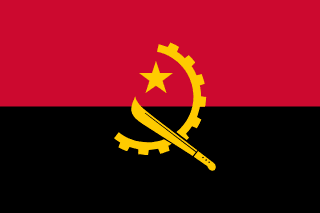
The flag of Angola was adopted on November 11, 1975, the day of independence. It is rectangular with a 2:3 aspect ratio, consisting of two equal horizontal bands: a red band on top and a black band on the bottom. At the center where the two bands meet is a yellow emblem—a half gear crossed with a machete, blade pointing upward, with a five-pointed star behind the gear. The red, black, and yellow color scheme is simple yet powerful, and the design gives the flag high recognizability.
Meaning
The official interpretation is: red symbolizes the struggle of ancestors under colonial oppression and the blood shed for independence, as well as ongoing social transformation; black represents the African continent. In the central yellow emblem, the gear symbolizes workers and industry, the machete symbolizes peasants and agriculture, their crossing represents the worker-peasant alliance, and the five-pointed star stands for progress and international solidarity. The flag encapsulates the language of the independence movement and is one of the most iconic designs among Africa’s “struggle narrative” flags.
History and Legal Status
The flag originated during the independence of Angola under the leadership of the Popular Movement for the Liberation of Angola (MPLA), and its design shares similarities with other socialist-aligned countries’ flags of the same era. According to the Constitution of the Republic of Angola and related laws on national symbols, the flag is one of the highest national symbols and must be displayed at government offices, schools, ports, and overseas missions. It is showcased nationwide during major national holidays (such as Independence Day on November 11 and Armed Struggle Day on February 4). Insulting or misusing the flag is subject to legal penalties. In 2003, there was a public proposal to change the flag and emblem, but the resulting designs sparked nationwide debate and were eventually shelved. The current flag remains in use today.
Angola Travel Guide
All Guides »Angola Travel Quick Guide: Visa in Advance, Dry Season, High Budget & Safety Tips
Be sure to arrange your visa well in advance—Luanda has some of the highest pric...
Classic 7-Day Angola Itinerary: Luanda — Kalandula Falls — Lubango Escarpment — Namib Edge 7 days
A central southern route: Luanda’s gulf capital, Kalandula’s mighty waterfall, t...
4-Day Luanda Deep Dive: Bay of Luanda, Forts, and Ilha Beach 4 Days
Explore the capital like a local: colonial forts, the Iron Palace, the Anthropol...
A must-visit attractions list in Angola: Kalandula Falls, Luanda Bay, and desert wonders
From Luanda Bay to the edge of the Namib Desert, we’ve curated 10 top sights acr...
Angola Food Guide: Hearty Funge, Calulu, and Seafood Feasts from the Benguela Current
Cassava porridge (fungue) and stews form the foundation, while charcoal-grilled ...
Complete Guide to Transportation in Angola: Domestic Flights, Negotiable Taxis, and Private Car Hire for Long-Distance Travel
How to handle traffic jams in Luanda, how to fly to inland cities, how to reach ...
10 Practical Travel Tips for Angola: Visa, Costs, and Safety Essentials
Advance visas, yellow fever vaccination, high-cost budgeting, nighttime safety, ...