Lithuania
The southernmost of the three Baltic states, known for its Baroque old town, lake castle on an island, Hill of Crosses, and Baltic amber.
Lithuania (Republic of Lithuania)
| Capital | Vilnius |
|---|---|
| Continent | Europe |
| Languages | Lithuanian |
| Currency | Euro (EUR €) |
| Time Zone | UTC+2 to UTC+3 |
| Dialling Code | +370 |
| Area / Population | 65,300 square kilometers / Approximately 2.8 million |
| Visa | Most foreign visitors need a Schengen visa to visit Lithuania. Applications can be submitted to the Lithuanian Visa Center or any Schengen country embassy or consulate. Required documents typically include a passport, travel itinerary, accommodation details, and travel insurance. The length of stay permitted will be shown on the visa. |
| Best Season | The most comfortable climate with the longest daylight hours is from May to September, making it the peak travel season; December to February is cold and snowy, ideal for experiencing Christmas markets and snowy landscapes. |
| Main Cities | Vilnius, Trakai, Kaunas, Klaipėda, Nida, Palanga, Šiauliai, Druskininkai |
Lithuania in Detail
About Lithuania
Lithuania (officially the Republic of Lithuania) is located in northeastern Europe on the eastern coast of the Baltic Sea and is the southernmost of the three Baltic states. It borders Latvia to the north, Belarus to the east and southeast, Poland to the southeast, and Russia’s Kaliningrad Oblast to the southwest, with the Baltic Sea to the west. The country covers an area of about 65,300 square kilometers, and its capital, Vilnius, situated in the southeastern part of the country, serves as the political, economic, and cultural center.
Lithuania is a parliamentary republic, with a president as the head of state and a prime minister leading the government. The country is divided into 10 counties, with a population of approximately 2.8 million. It is a member of the European Union, NATO, the Schengen Area, and the Eurozone. Due to its location at the crossroads of East and West, Lithuania has historically been a corridor for trade and culture, leaving a diverse imprint on its architecture and language.
Geography and Climate
Lithuania has a flat terrain, mainly consisting of low moraine hills and plains. Its highest point, Aukštojas Hill, reaches only 293.84 meters above sea level. The country has numerous lakes—over 2,800 in total—with the Nemunas River being the main waterway, flowing from Belarus and emptying into the Baltic Sea near Klaipėda. Forests cover about 30% of the land, and the Curonian Spit, a narrow sand dune peninsula separating the Baltic Sea from the Curonian Lagoon and shared with Russia’s Kaliningrad Oblast, is a UNESCO World Natural Heritage site.
The climate is a transitional type between maritime and continental, with cold, snowy winters (average January temperature around -5°C) and mild summers (average July temperature around 17–18°C). Coastal Palanga enjoys cool summers and is the country’s most popular beach destination. The best travel season is from May to September, with the period around midsummer (late June) featuring extremely long days and very short nights.
Historical Background
Lithuania’s history dates back to the 13th century: in 1253, Mindaugas was crowned king, establishing the Grand Duchy of Lithuania, which at one point was one of the largest countries in Europe. In 1386, the Grand Duke of Lithuania, Jogaila, married into the Polish royal family, and in 1569, the two countries formally united as the Polish–Lithuanian Commonwealth through the Union of Lublin, becoming one of the most populous and extensive states in Europe at the time.
In 1795, the Commonwealth was partitioned three times by the Russian Empire, Prussia, and Austria, leading to its dissolution and the incorporation of Lithuania into Russia. Lithuania declared independence at the end of World War I in 1918, was annexed by the Soviet Union in 1940, and subsequently experienced Nazi German occupation and the Soviet era. On March 11, 1990, Lithuania was the first Soviet republic to declare the restoration of independence; it gained widespread international recognition in 1991, joined NATO and the EU in 2004, and officially adopted the euro on January 1, 2015.
Economy and Currency
Lithuania is a small, highly open developed economy. It has competitive sectors in laser technology, biotechnology, financial technology, information and communications, wood processing, and food industry, with services accounting for about two-thirds of the economy. The official currency is the euro (EUR), which replaced the former Lithuanian litas (LTL) in 2015. As a Schengen Area member, Lithuania enjoys seamless overland travel with Latvia and Poland without border checks.
Culture and Society
Lithuanian is one of the oldest living Indo-European languages, retaining many archaic features of the proto-language and considered a linguistic fossil for studying language evolution. The dominant religions are Orthodox Christianity and Catholicism. The society values education and etiquette, and both the Baltic Song Festival and choral traditions are recognized as UNESCO Intangible Cultural Heritage.
As for food, potatoes take center stage: cepelinai (potato dumplings filled with meat, resembling airships), potato pancakes (bulviniai blynai), and pink cold beet soup (šaltibarščiai) are must-try national dishes. Rye bread and cheese are also iconic. Basketball is the national sport, and the Lithuanian national team consistently ranks among Europe’s best. Lithuania is also famous for its Baltic amber, known as the “Land of Amber,” with amber museums and shops in Palanga and Vilnius.
Tourism Overview
Though small in size, Lithuania boasts a variety of attractions including Baroque old towns, lake castles, dune coastlines, and religious wonders. Vilnius Old Town is one of the largest and best-preserved Baroque old towns in Northern Europe and a UNESCO World Heritage Site; the bohemian “Republic of Užupis” district in the southern part of the city is known for its artistic vibe and self-declared constitution. Trakai Castle, situated on Lake Galvė, is Lithuania’s most picturesque sight; the Hill of Crosses near Šiauliai, with its hundreds of thousands of crosses, is a unique pilgrimage site worldwide.
Additionally, Kaunas combines a historic old town with 20th-century modernist architecture; Klaipėda offers seaside charm and the dunes of the Curonian Spit; and Druskininkai is known for its spa resorts—all creating appealing options for both short trips and deeper exploration. With good safety, reasonable prices, and clear public transport, it is often an underrated stop on Baltic routes.
Local Currency: Euro (EUR)
Currency Overview
The official currency of Lithuania is the euro (currency code: EUR, symbol: €). It officially replaced the former currency, the litas (LTL, symbol: Lt), on January 1, 2015. The euro is managed by the European Central Bank (ECB), headquartered in Frankfurt, Germany, which sets monetary policy for the euro area. Euro banknotes are issued by the central banks of the eurozone countries, while coins are minted nationally, with a common design on one side and country-specific designs on the other. Euros are freely circulated across the 20 eurozone member states. One euro equals 100 cents. Lithuania was approved to join the eurozone by the EU Council in July 2014 and officially adopted the euro on January 1, 2015, with a fixed conversion rate of 1 euro = 3.4528 litas. The euro is the world’s second-largest reserve and foreign exchange trading currency after the US dollar.
Denominations
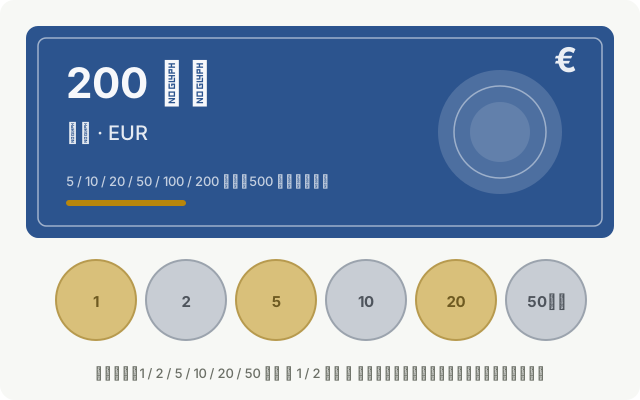
Euro banknotes come in seven denominations: €5, €10, €20, €50, €100, €200, and €500. The front features architectural styles such as windows and arches, symbolizing openness, while the back shows bridges, representing connection. Different denominations are color-coded—for example, €5 (grey), €10 (red), €20 (blue), €50 (orange), €100 (green). The designs are inspired by various historical architectural periods, avoiding specific people or real buildings to prevent controversy. Coins come in eight denominations: 1, 2, 5, 10, 20, 50 cents, and €1, €2. The common side displays a map of Europe and the denomination, while the national side varies by issuing country.
Lithuania’s euro coins feature the national coat of arms “Vytis” (a mounted knight) on the national side. While minor differences exist between low-denomination (1, 2, 5 cent) and high-denomination (10, 20, 50 cent, €1, €2) coins, all prominently display the knight on horseback with a raised sword and the inscription “LIETUVA” (Lithuania) along with the year of minting—making it the most recognizable feature of Lithuanian coins.
Cash and Payment Habits
Lithuania is one of the more cashless eurozone countries, with widespread acceptance of international cards like Visa and Mastercard, as well as mobile payments such as Apple Pay and Google Pay in supermarkets, restaurants, hotels, buses, and convenience stores. However, small purchases at markets, rural shops, church donations, or some public toilets may still require cash, so it’s wise to carry small euro bills. In major cities like Vilnius, Kaunas, and Klaipėda, cashless payments are very common, with payment terminals usually accepting both contact and contactless cards. Payments can be made by tapping your card or using your phone. ATMs are widely available in urban areas and airports, though withdrawal fees may apply—consider withdrawing larger amounts to reduce costs.
Traveler Tips
- Lithuania uses the euro, so there’s no need to exchange money when traveling to neighboring countries like Latvia, Estonia, or Poland.
- The old litas banknotes and coins are no longer in circulation, so there’s no need to carry or exchange LTL.
- Non-euro currencies (such as the Polish zloty) are generally not accepted in Lithuania; exchange them before arrival.
- Restaurant bills usually include taxes. Tipping is voluntary and based on service satisfaction, typically around 5–10%.
Flag Meaning
Flag Design
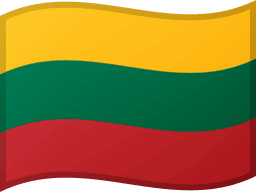
The Lithuanian flag is a horizontal tricolor composed of three equal horizontal stripes: yellow on top, green in the middle, and red on the bottom, in a 3:5 ratio. The officially defined colors are warm gold, deep green, and a slightly brick-red dark red—not the brightest primary shades. In addition to the civil flag, Lithuania also has a “historical flag” (state flag): a red field with the white knight emblem “Vytis” in the center, used at government buildings, embassies, and formal ceremonies. Government buildings, schools, and diplomatic missions are required to raise and lower the flag according to official protocols and display it in the manner prescribed by the Flag Law.
Meaning
Yellow symbolizes the sun, light, and prosperity; green represents nature, vegetation, vitality, and hope; red stands for the earth, courage, and the blood shed to defend the homeland. Together, the three colors reflect the Lithuanian people’s sentiments toward freedom and traditional agrarian life. The “Vytis” emblem depicts a white knight on horseback holding a silver sword, a symbol of the state dating back to the 14th-century Grand Duchy era. Additionally, the Lithuanian flag is commonly waved by the public during parades, celebrations, and sports events, and the tricolor design frequently appears on traditional clothing, souvenirs, and sports jerseys, serving as a powerful everyday symbol of national identity.
History and Legal Status
The tricolor flag was first proposed during the Lithuanian national revival in the late 19th century and was officially adopted when Lithuania declared independence in 1918. It was banned during the Soviet era but was reinstated by the independence-seeking “Sąjūdis” movement in 1988 and officially readopted as the national flag in 1989. In 2004, Lithuania passed the Flag Law, specifying color standards, proportions, and appropriate usage, and formally recognizing the Vytis flag as the historical national flag. When the independence declaration was read on March 11, 1990, the tricolor flag was raised over the parliament building, marking it as a key symbol of renewed national sovereignty. Today, the flag is prominently displayed on national holidays such as Independence Day (February 16) and Restoration of Independence Day (March 11).
Lithuania Travel Guide
All Guides »Lithuania Travel Quick Guide: Schengen Visa, Best Seasons, Daily Budget & Local Etiquette & Taboos
Get clarity on the Schengen visa, seasonal choices, daily budget, and local etiq...
Classic 7-Day Lithuania Itinerary: Vilnius – Trakai – Kaunas – Curonian Spit 7 days
From Baroque Old Towns to lakeside castles on islands, and then to the dune-line...
Lithuania 4-Day Itinerary: Exploring Vilnius Old Town and Trakai Water Castle 4 days
Even with limited time, you can have a fulfilling trip: base yourself in Vilnius...
Essential Attractions in Lithuania: Baroque Old Towns, Lakeside Castles, and Amber Coast
From the baroque alleys of Vilnius to the lakeside castle and dune coast of Trak...
Lithuanian Food Guide: From Potato Dumplings to Pink Cold Beet Soup and Tree Cake
Lithuanian cuisine is built almost entirely on potatoes, rye, and sour cream. Th...
Lithuania Transport Guide: Getting from Airports to Cities, Public Transit, and Inter-City Trains and Buses
How to get into town from Vilnius, Kaunas, and Klaipėda airports, how to buy and...
10 Practical Travel Tips for Lithuania: Visa, Payments & Etiquette to Avoid Pitfalls
From Schengen visas and currency exchange to amber shopping, bus ticket validati...