Equatorial Guinea
One of the few African countries where Spanish is an official language, it consists of mainland rainforests and volcanic islands, with abundant but unevenly distributed oil and gas resources.
Equatorial Guinea (Republic of Equatorial Guinea)
| Capital | Malabo |
|---|---|
| Continent | Africa |
| Languages | Spanish, French |
| Currency | Central African CFA franc (XAF FCFA) |
| Time Zone | UTC+1 |
| Dialling Code | +240 |
| Area / Population | Approximately 28,000 square kilometers / Approximately 1.7 million |
| Visa | Most foreign visitors need a visa to enter Equatorial Guinea; visa-free entry or visa on arrival is not available. Applications can currently be submitted through the Equatorial Guinean embassy in your country or authorized visa agencies. Required documents typically include a passport valid for at least 6 months, a completed visa application form, passport-sized photos, proof of yellow fever vaccination (yellow card), and a certificate of no criminal record, among others. The visa fee is approximately 100–120 USD, and it is recommended to apply at least one month in advance. The embassy has also introduced an e-visa option; please check the latest information from the relevant embassy or consulate before traveling. |
| Best Season | The climate is hot and rainy year-round. The period from December to March is relatively dry and is a better time to visit Bioko Island and the mainland rainforests. From April to November, rainfall is concentrated, humidity is higher, and there are more mosquitoes, so protective measures are needed when traveling. |
| Main Cities | Malabo, Bata, Bioko Island, Pico Basilé volcano, Moka Valley, Annobón Island, Luba, Mongomo |
Equatorial Guinea in Detail
Overview of Equatorial Guinea
Equatorial Guinea (officially the Republic of Equatorial Guinea) is located in central-western Africa and consists of the continental region of Río Muni and islands in the Gulf of Guinea, including Bioko Island and Annobón Island. It borders Cameroon to the north, Gabon to the east and south, and the Atlantic Ocean to the west. The country covers an area of approximately 28,000 square kilometers, making it one of the smaller countries in Africa.
The capital, Malabo, is located at the northern end of Bioko Island and is one of the few countries in Africa where the capital is situated on an island. The largest city on the mainland is Bata. Spanish is the primary official language, and French is also an official language, making Equatorial Guinea one of the few African countries where Spanish holds official status. The national population is around 1.7 million. Administratively, the country is divided into two main regions—mainland and islands—comprising a total of eight provinces.
Geography and Climate
The country is divided into two main parts: the continental region of Río Muni, which features coastal plains gradually rising to inland hills and plateaus, covered by vast tropical rainforests; and the insular region, primarily consisting of Bioko Island, a volcanic island. The northern tip of Bioko is home to Pico Basilé, which rises about 3,008 meters above sea level and is the highest peak in the country. The mountain features several volcanic crater lakes and cloud forests. Annobón Island, further southwest, is also a volcanic island.
Equatorial Guinea has a tropical rainforest climate, characterized by high temperatures, heavy rainfall, and high humidity throughout the year. The continental region experiences distinct dry and wet seasons: relatively dry from December to March, and with concentrated rainfall from April to November. Bioko Island receives even heavier rainfall, and the Moka Valley area is often shrouded in clouds, forming a famous rainy and foggy forest zone. Travel is more comfortable during the dry season, while mosquito protection and road accessibility should be considered during the rainy season.
Historical Background
Bioko Island was discovered by Portuguese navigators in the 15th century, and over the following centuries, Portugal, the Netherlands, and Britain were active in the Gulf of Guinea. In 1778, Portugal ceded the islands of Bioko and Annobón, along with trading rights on the mainland, to Spain, marking the beginning of Equatorial Guinea’s period of Spanish colonization. Spanish language and Catholicism took root during this time. In the 20th century, Bioko Island became an important cocoa-producing region, with a once-thriving plantation economy.
Equatorial Guinea gained independence from Spain in 1968. Since then, it has undergone extended periods of political instability and authoritarian rule. From the mid-1990s, large-scale oil and natural gas reserves were discovered in the Gulf of Guinea, dramatically altering the nation’s economic structure. However, governance practices and the distribution of social wealth have remained under international scrutiny.
Economy and Currency
Equatorial Guinea’s economy is highly dependent on oil and natural gas exports. Thanks to revenues from these resources, its GDP per capita has long ranked among the highest in Africa, even briefly surpassing that of some middle-income countries. However, resource wealth is highly concentrated, resulting in limited improvement in living standards and infrastructure for the general population. There are significant disparities between urban and rural areas, and between the islands and the mainland. The economy is structurally undiversified and vulnerable to external shocks. The official currency is the Central African CFA franc (XAF), issued by the Bank of Central African States, and pegged to the euro at a fixed exchange rate.
Culture and Society
Equatorial Guinean culture is rooted in Bantu traditions, layered with the languages, religions, and festivals introduced during Spanish colonization, creating a distinctive Spanish-African flavor. The majority of the population is Catholic, and music and dance are vibrant. Folk customs differ between Bioko Island and the mainland. The Moka Valley region preserves cloud forests and a native population of drills (a type of primate), making it an important area for biodiversity. Local infrastructure and tourism services are relatively limited, with lower capacity compared to more developed tourism markets in East and Southern Africa.
Tourism Overview
Equatorial Guinea boasts outstanding natural assets: the volcanoes, crater lakes, and cloud forests of Bioko Island; hiking routes on Pico Basilé; the misty forests and primate reserves of the Moka Valley; and the rainforests and beaches around Bata on the mainland—all offering strong natural appeal. However, due to visa restrictions, limited flight options, inadequate tourism facilities, and the requirement for prior permission to access certain areas, independent travel is challenging. Most foreign visitors come for business or family visits. Those planning to visit should arrange visas and itineraries several months in advance, prioritize established destinations such as Malabo, Bata, and Bioko Island, and explore rainforests and protected areas with professional guides.
Local Currency: Central African CFA franc (XAF)
Currency Overview
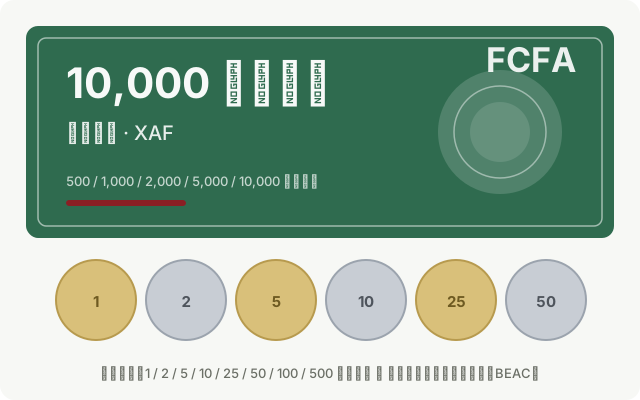
The official currency of Equatorial Guinea is the Central African CFA franc (currency code: XAF, symbol: FCFA). Issued by the Bank of Central African States (BEAC), it circulates in six countries: Cameroon, Central African Republic, Chad, Republic of the Congo, Gabon, and Equatorial Guinea. The currency is pegged to the euro at a fixed exchange rate (approximately 655.957 XAF per 1 euro), making it relatively stable. Equatorial Guinea does not issue its own currency, and the CFA franc is legal tender within the country. Since joining the Central African Monetary Zone in 1985, the previously used national currency, the ekwele, has been withdrawn and replaced by the unified CFA franc.
Denomination System
CFA franc banknotes are issued in denominations of 500, 1,000, 2,000, 5,000, and 10,000 francs, featuring designs representing the BEAC and member states. Coins come in denominations of 1, 2, 5, 10, 25, 50, 100, and 500 francs. As the U.S. dollar and other foreign currencies are widely used in business and tourism, exchange rates between the franc and the dollar fluctuate daily.
Cash and Payment Practices
Cash transactions are predominant in Equatorial Guinea, especially in markets, taxis, and for small purchases. Hotels, shopping malls, and larger restaurants in Malabo and Bata may accept Visa and Mastercard, but coverage is limited, and ATMs are mainly found in urban areas. The U.S. dollar is commonly accepted, particularly for large purchases and hotel payments. It is advisable to carry newer, undamaged dollar bills to avoid issues with acceptance.
Traveler Tips
- It is recommended to carry a moderate amount of euro or U.S. dollar cash and exchange it for CFA francs at banks or authorized exchange points upon arrival.
- Credit card acceptance is limited; carry sufficient cash when visiting rural areas or islands.
- The CFA franc is fixed to the euro, ensuring stable exchange rates without major fluctuations.
- Large transactions are often quoted in U.S. dollars; confirm the currency and exchange rate before payment.
Flag Meaning
Flag Design
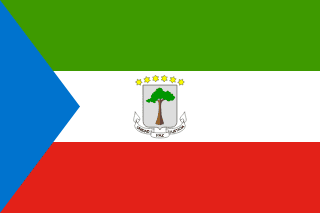
The flag of Equatorial Guinea consists of three horizontal stripes: green at the top, white in the middle, and red at the bottom. On the hoist side is a blue isosceles triangle, with the national coat of arms centered within it. The flag has an approximate aspect ratio of 3:2.
Meaning
Green symbolizes the country’s forests and agricultural resources, white represents peace, red stands for the struggle for independence, and the blue triangle signifies the ocean connecting the mainland and the islands. The central coat of arms features a silk-cotton tree (also known as a ceiba or God tree), symbolizing the historical foundation of the nation and its people. Above the tree are six white five-pointed stars representing the various regions of the mainland and islands. Below the tree is a ribbon bearing the national motto in Spanish, meaning “Unity, Peace, Justice.” The silk-cotton tree is regarded as a native giant tree, symbolizing the country’s roots in Africa, while the six stars represent the equal status of all regions within the unified nation.
History and Legal Status
Equatorial Guinea adopted its first flag upon independence in 1968. Between 1973 and 1979, a different version with alternate designs was used, but the current green-white-red tricolor with the blue triangle was reinstated in 1979 and has been in use since, with subsequent revisions to the details of the coat of arms. The flag is widely displayed at government buildings, embassies, schools, and sporting events, serving as an important symbol of national identity. The evolution of the flag since independence reflects the country’s positioning amid its colonial legacy and the relationship between its islands and mainland.
Equatorial Guinea Travel Guide
All Guides »Equatorial Guinea Travel Quick Guide: Visa, Seasons, Budget & Etiquette
Visas are strict and flights are limited—clarify procedures, seasons, and budget...
7-Day Equatorial Guinea Itinerary: Malabo — Bioko Island — Bata on the Mainland 7 days
Explore Bioko Island starting from the capital, Malabo, then fly to Bata on the ...
Equatorial Guinea 4-Day Itinerary: Highlights of Malabo and Bioko Island 4 days
Based in the capital Malabo, explore urban neighborhoods, volcanic highlands, an...
Essential Attractions in Equatorial Guinea: Malabo, Bioko Island, and the Mainland Rainforest
From volcanic highlands to cloud forest reserves, mainland rainforests, and coas...
Equatorial Guinea Food Guide: Cassava, Plantains, and a Fusion of Central and West African Flavors
Influenced by Spanish colonial history and Bantu traditions, Equatorial Guinean ...
Equatorial Guinea Travel Guide: Airport Transfers, Island-Mainland Flights, and Local Transport
Flights connect the islands and the mainland, while taxis and minibuses are the ...
10 Practical Tips for Traveling in Equatorial Guinea
Visa, health, and cash are the three key considerations. Understanding these det...