Dominica
Dominica, the Caribbean’s one-of-a-kind “Nature Island,” is famed for its Boiling Lake, rainforests, Champagne Reef diving, and indigenous territories.
Dominica (Commonwealth of Dominica)
| Capital | Roseau |
|---|---|
| Continent | North America |
| Languages | English |
| Currency | Eastern Caribbean Dollar (XCD EC$) |
| Time Zone | UTC-4 |
| Dialling Code | +1767 |
| Area / Population | 751 square kilometres / Approximately 72,000 |
| Visa | Most foreign visitors need to apply for a visa in advance through a Dominican diplomatic mission abroad or via the Electronic Travel Authorization system. Ferries or small planes are available from places such as Antigua and Saint Lucia—confirm the latest entry requirements before travel. |
| Best Season | The dry season from December to May is the best window for hiking and diving. The rainy season (June–November) brings high waterfall volumes, but avoid the peak hurricane period. |
| Main Cities | Roseau, Portsmouth, Trafalgar, Scotts Head, Kalinago Territory, Soufrière Valley, Cabrits |
Dominica in Detail
About Dominica
Dominica (officially the Commonwealth of Dominica) is located in the central part of the Lesser Antilles in the Eastern Caribbean, nestled between the French islands of Guadeloupe and Martinique. Covering an area of approximately 751 square kilometres, it has a population of just over 70,000, making it one of the least populous countries in the Caribbean. Its capital, Roseau, is situated on the southwest coast and serves as the political and economic hub. Please note: Dominica is not to be confused with the much larger, Spanish-speaking Dominican Republic—their English names differ by just one letter (Dominica vs. Dominican Republic), so double-check when booking flights or accommodation.
As a member of the Commonwealth, Dominica gained independence from the United Kingdom on November 3, 1978, and operates under a parliamentary system, with English as the official language. Unlike its beach-focused neighbours, Dominica lacks vast stretches of white sand beaches. Instead, it markets itself as the “Nature Island of the Caribbean”: volcanoes, rainforests, waterfalls, hot springs, and coral reefs define its landscape.
Geography and Climate
Dominica is a young volcanic island with rugged, steep terrain. Its highest peak, Morne Diablotins, rises 1,447 metres above sea level. The island features dense mountain ranges, deep valleys, and a network of rivers that flow year-round, resulting in the Caribbean’s most concentrated collection of waterfalls and more than 365 rivers. The Boiling Lake in Morne Trois Pitons National Park is the world’s second-largest hot spring lake, with water that perpetually bubbles and churns. The hike to and from the lake takes six to eight hours and is one of the island’s most challenging trails. Near Champagne Reef, volcanic bubbles rise continuously from the seafloor, creating a surreal, champagne-like effect while diving—one of the rarest underwater experiences in the world.
The climate is tropical and oceanic, with persistent cloud cover in the mountains and extremely high annual rainfall. The inland rainforest is among the best-preserved in the Eastern Caribbean. Hurricane season runs from June to November. In 2017, Hurricane Maria severely damaged the island, prompting Dominica to rebuild with the goal of becoming the “world’s first climate-resilient nation.” Ecological restoration and sustainable tourism have since become national priorities.
Historical Background
Dominica was originally inhabited by the indigenous Kalinago people. Christopher Columbus arrived here on a Sunday in 1493 and named it Dominica, meaning “Sunday” in Latin. Due to its rugged terrain and strong resistance from the indigenous people, it was one of the last Caribbean islands to be colonized by Europeans. The island was contested by the British and French throughout the 18th century before finally coming under British control in 1805. It gained internal self-government in 1967 and became fully independent in 1978.
Today, Dominica is home to the Eastern Caribbean’s only remaining organized indigenous territory—the Kalinago Territory on the east coast. Around 3,000 descendants of the Kalinago people live here, preserving traditions such as canoe-building, weaving, and herbal medicine. It stands as one of the few living indigenous cultural communities in the Americas.
Economy and Currency
Dominica’s economy has long relied on exports of agricultural products such as bananas, coconuts, and citrus fruits. In recent years, it has shifted focus to ecotourism and the Citizenship by Investment (CBI) program as economic pillars. The official currency is the Eastern Caribbean Dollar (XCD), which is pegged to the US dollar at a fixed rate of 2.7 XCD to 1 USD and issued by the Eastern Caribbean Central Bank. Agriculture is transitioning toward organic farming and boutique production of single-origin cocoa and coffee, with island chocolate workshops and cocoa estate tours emerging as new tourist attractions.
Culture and Society
The population of Dominica is predominantly Afro-Caribbean, along with a unique group of indigenous Caribbean people. While English is the official language, a French-based Creole is widely spoken informally. The annual Creole Festival in October combines Independence Day celebrations with traditional music and cuisine. Cultural highlights include the traditional Bele dance, drum rhythms, and Kalinago canoe races. The pace of life is relaxed, community ties are strong, and large chain stores are virtually nonexistent—family-run eateries and roadside juice stalls dominate the scene.
Tourism Overview
Dominica’s tourism appeal lies in hiking and nature. Attractions like Trafalgar Falls, Emerald Pool, and Middleham Falls are often tucked within national park rainforests, accessible only via slippery trails. The Waitukubuli National Trail, stretching about 185 kilometres across the island, is the longest hiking route in the Caribbean. Diving and snorkelling are centred around Champagne Reef and Scotts Head on the southwest coast, where year-round whale-and-dolphin-watching tours (including resident sperm whales) are a highlight. With its sparse tourist crowds and pristine ecology, Dominica caters to outdoor enthusiasts and those seeking off-the-beaten-path adventures—not luxury resort seekers.
Local Currency: Eastern Caribbean Dollar (XCD)
Currency Overview
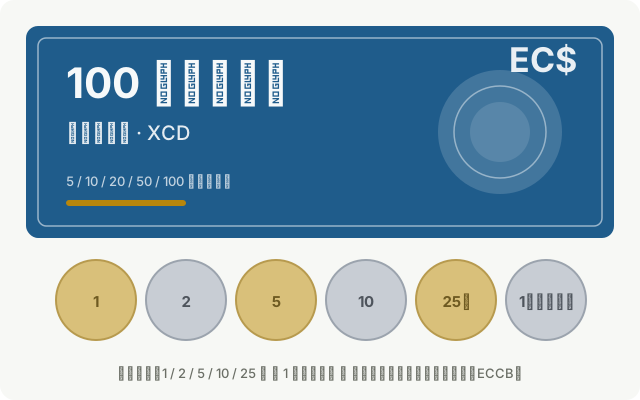
The Eastern Caribbean Dollar (currency code XCD, symbol EC$) is the official currency of Dominica, issued by the Eastern Caribbean Central Bank (ECCB). It is used across Dominica and other members of the Eastern Caribbean Currency Union, including Grenada, Saint Lucia, Saint Vincent and the Grenadines, Antigua and Barbuda, Saint Kitts and Nevis, Montserrat, and Anguilla, making it a regional currency. Since 1976, the Eastern Caribbean Dollar has been fixed at 2.7 XCD to 1 USD—a rate that has remained unchanged for decades. Travellers can easily manage currency exchange and budgeting without worrying about fluctuations.
Denominations
Banknotes come in denominations of 5, 10, 20, 50, and 100 Eastern Caribbean Dollars. Their designs reflect themes of the Eastern Caribbean Currency Union. The front typically features a portrait of Queen Elizabeth II (in current issues) or a watermark area with her image, while the back showcases regional landscapes such as sailboats, rainforests, and lighthouses. Coins are issued in 1, 2, 5, 10, 25 cents, and 1 dollar, with some smaller coins featuring polygonal shapes for easier identification by the visually impaired.
Cash and Payment Practices
Roseau has several banks and ATMs, and Visa credit cards are accepted at hotels and larger restaurants. However, the card payment infrastructure is far less developed than in major cities: rural shops, taxis, boat operators, and most attraction ticket booths only accept cash. Hiking tour deposits, scuba diving shop payments, and island-hopping car rentals also generally require cash. It’s advisable to withdraw enough cash in Roseau upon arrival or on your first day. ATMs are scarcer in northern Portsmouth and may run out of cash.
US dollars are widely accepted, with merchants typically using an approximate exchange rate of 1 USD to 2.6–2.7 Eastern Caribbean Dollars. Change is usually given in Eastern Caribbean Dollars, so smaller bills are most practical.
Traveller Tips
- The Eastern Caribbean Dollar is fixed at 2.7:1 against the US Dollar—use this rate for quick mental conversions without needing to check live rates.
- ATMs are limited on the island. Withdraw enough cash for several days on your first day in Roseau.
- Smaller denominations (5 and 10 XCD) are most useful—accepted at national park entrances, juice stalls, and boat operators.
- Credit cards are only accepted at established businesses (typically credit, not debit), and debit card acceptance is limited. Don’t rely solely on card payments across the island.
Flag Meaning
Flag Design
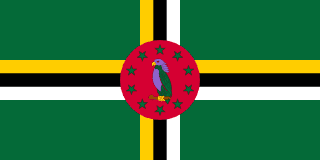
The flag of Dominica is rectangular, with a 1:2 aspect ratio. The background is green, featuring a central cross made up of three vertical and three horizontal stripes in yellow, black, and white (outer yellow, middle black, outer white). At the center of the cross is a red circle containing a Sisserou parrot (imperial amazon) perched on a twig, surrounded by ten green five-pointed stars arranged in a ring. This design makes Dominica’s flag one of the few modern national flags to feature an animal as its central motif.
Meaning
Green symbolises the island’s lush rainforests and thriving agriculture, directly reflecting its identity as the “Nature Island.” The three colours of the cross represent unity and natural gifts: yellow stands for the sun, citrus fruits, and both indigenous and immigrant peoples; black represents the fertile volcanic soil; and white signifies the island’s clear rivers and waterfalls. Together, they signify racial diversity and nature’s bounty. The red circle symbolises social equality and the warmth of the people, while the ten green stars arranged in a circle represent the island’s ten parishes and embody equality and unity. The Sisserou parrot, native to Dominica, reflects the country’s unique biodiversity and aspirations for growth.
History and Legal Status
The current flag was adopted on November 3, 1978, the day of Dominica’s independence, and was designed by artist Alwin Bully, reflecting the country’s name and natural identity. The flag underwent minor adjustments in 1981 and 1988, with the most recent change in 1990 switching the stars beneath the parrot from a linear to a circular arrangement—which remains in use today. The Flag and Coat of Arms Act specifies precise standards for the parrot’s posture, the width and colours of the cross, and other elements. The flag is prominently displayed during national events such as Independence Day (November 3), national holidays, and the Creole Festival, serving as a powerful symbol of national pride.
Dominica Travel Guide
All Guides »Dominica Travel Quick Guide: Visa, Season, Budget & Hiking Prep
Exploring a natural island is nothing like a resort getaway: secure your visa, p...
Dominica Classic 7-Day Itinerary: Boiling Lake — Middleham Falls — Champagne Reef 7 days
A route that covers the best of this natural island gem: the world’s second-larg...
Dominica 4-Day Short Trip: Essential Nature Route Around Roseau 4 Days
See the highlights even with limited time: Twin Falls, Emerald Pool, Hot Spring ...
Must-visit Attractions in Dominica: Boiling Lake, Waterfalls, and Indigenous Territories
A complete list of this natural island’s top sights: the world’s second-largest ...
Dominica Food Guide: Creole Flavors, Mountain River Fish, and Cocoa Workshops
Even on this nature-filled island, the dining scene shines: green banana dishes,...
Complete Travel Guide to Transportation in Dominica: Connecting Flights, Island-Wide Car Rentals, and Ferries
A clear breakdown of indirect flight routes, scenic mountain-road car rentals, a...
Practical Travel Tips for Dominica: Hiking, Cash, Guides, and Eco Rules
Ten Key Tips for the Nature Isle: How to Hire a Boiling Lake Guide, How Much Cas...