Niue
A coral atoll nation in free association with New Zealand in the South Pacific, known for its coral cliffs, sea caves, free nationwide Wi-Fi, and whale-watching season from July to October, with a population of less than 2,000.
Niue

| Capital | Alofi |
|---|---|
| Continent | Oceania |
| Languages | English, Niuean |
| Currency | New Zealand Dollar (NZD NZ$) |
| Time Zone | UTC-11 (no daylight saving time) |
| Dialling Code | +683 |
| Area / Population | Approximately 260 square kilometers / Approximately 1,700 people |
| Visa | Most foreign visitors are not eligible for visa-free entry to Niue and must apply for a visitor visa in advance through the Niue Immigration Office (visas are typically valid for 30 days and may be extended in Alofi). Flights to Niue are only available via Auckland, New Zealand, so travellers will also need a New Zealand NZeTA or a suitable transit or tourist visa for the connecting flight. Entry requirements are subject to the latest regulations from the relevant embassies, consulates, and the Niue Immigration Office. |
| Best Season | The best time to visit is during the dry season from May to October, when the weather is stable and the water is clear; the humpback whale season runs from July to October, offering opportunities for whale watching from clifftops or swimming with whales; the rainy season and cyclone season last from November to April, so monitor weather conditions when traveling. |
| Main Cities | Alofi, Avatele, Hakupu, Mutalau, Liku, Tamakautoga, Vaiea |
Niue in Detail
Niue Overview
Niue is located in the central South Pacific, part of Polynesia, situated about 2,400 kilometers northeast of Auckland, New Zealand, east of Tonga, and west of the Cook Islands. The country consists of a raised coral atoll with an area of approximately 260 square kilometers, making it one of the largest raised coral atolls in the world. The capital, Alofi, is located on the western coast of the island and serves as the main town and administrative center.
Niue is in free association with New Zealand. It gained self-government through a referendum on October 19, 1974, and has its own constitution, parliament, and government. Defense and foreign affairs are managed by New Zealand, and Niueans are also New Zealand citizens. Niue is not a member of the United Nations. With a population of fewer than 2,000, it is one of the smallest societies in the world. Due to limited employment and education opportunities, many Niueans have emigrated to New Zealand, where the overseas Niuean population far exceeds that of the home island.
Geography and Climate
Niue is not a typical atoll but a limestone island formed by the uplifting of a volcanic base with coral reefs. The central part is a plateau about 60 meters above sea level, surrounded by steep coral cliffs dropping into the deep sea, which is why the country has almost no beaches—most coasts consist of coral cliffs and reef platforms, with only a few small sandy areas such as Hio, Utuko, and Avatele on the western and northwestern coasts. There are no rivers on the island, and rainwater quickly seeps into the limestone, forming a network of caves and sea tunnels.
The eastern part of the island is home to the Huvalu Forest Conservation Area, an important habitat for native forests and bird species. The climate is tropical maritime, with a dry season from May to October characterized by stable weather and low humidity, making it the best time to visit. The rainy season and cyclone season run from November to April, with concentrated rainfall. Due to the great depth of the coastal waters and crystal-clear visibility, underwater visibility around Niue can reach several dozen meters year-round.
Historical Background
The ancestors of the Niueans migrated from Samoa and Tonga around 900 to 1000 AD, forming a society centered around villages and extended families. In 1774, British navigator Captain James Cook visited the island but, due to the locals' wariness, named it Savage Island. Missionaries arrived in the 19th century, and Christianity gradually became central to social life.
In 1900, at the request of the king and chiefs, Niue became a British protectorate and was placed under New Zealand administration in 1901. In the late 20th century, as the desire for self-governance grew, a referendum was held on October 19, 1974, leading to the adoption of a constitution and the establishment of Niue as a self-governing country in free association with New Zealand. This day is celebrated as Constitution Day. In 1975, Niue enacted a flag law and adopted its current national flag.
Economy and Currency
Niue has a very small economy, primarily reliant on economic aid from New Zealand, government spending, a modest tourism industry, and agriculture and handicrafts. Agricultural products include taro, cassava, coconuts, vanilla, and honey, while handicrafts mainly involve weaving and hiapo (bark cloth). There is no goods and services tax (GST), the equivalent of a sales tax, but most goods are imported, resulting in relatively high prices.
Niue uses the New Zealand Dollar (NZD) as its legal tender and does not have an independent circulating currency. It also issues a small number of commemorative coins, mostly for collectors. There is only one bank and one ATM on the island, and foreign currency exchange is not available locally. Travelers should exchange for New Zealand Dollars in advance in New Zealand or elsewhere.
Culture and Society
Niuean culture is part of Polynesian heritage. The country consists of 14 villages with strong community ties, deep family and land connections. Niuean and English are both official languages, and church life plays an important role. Most shops and restaurants are closed on Sundays, as residents attend church services. Handwoven straw hats, bags, and shell jewelry are among the most representative souvenirs, while hiapo bark cloth craftsmanship is considered a traditional art form.
Life here moves at a slow and peaceful pace: there are no traffic lights or chain fast-food outlets on the island. Niue is also one of the first places in the world to offer free Wi-Fi to all residents and visitors, a government-supported initiative that allows free internet access in most public areas.
Tourism Overview
Niue is ideal for travelers seeking tranquility and immersive nature experiences. The Talava Arch, Matapa Chasm, and Limu Pools on the northwest coast are popular spots for snorkeling and swimming. The Togo Chasm in the east, accessible through the Huvalu Forest and coral platforms, is an iconic natural wonder. Avaiki Cave and numerous sea caves offer opportunities for cave exploration. The deep offshore waters provide excellent diving conditions, with underwater caves and coral walls being favorite sites for divers.
From July to October each year, humpback whales migrate to the waters near Niue to breed and raise calves, offering opportunities for whale watching from clifftops or participating in licensed whale-watching and swimming programs. Spinner dolphins, commonly seen year-round, are another highlight. Known as the “Land of the Midnight Sky,” Niue has minimal light pollution, making it perfect for stargazing. Flights to and from Niue go via Auckland, New Zealand, typically once a week, so it’s advisable to plan for a stay of at least a week to fully enjoy the experience.
Local Currency: New Zealand Dollar (NZD)
Currency Overview
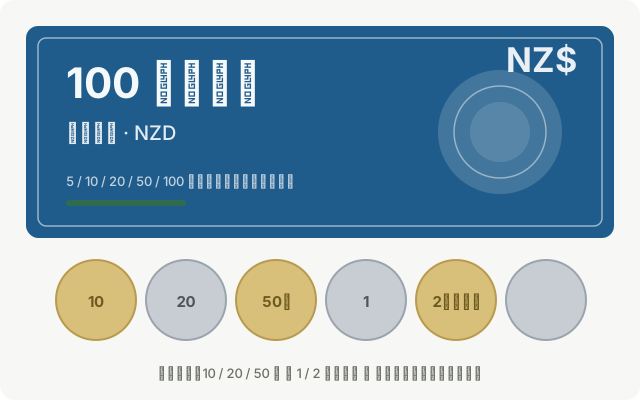
Niue does not have its own circulating currency. The official currency is the New Zealand Dollar (currency code NZD, symbol NZ$). This arrangement stems from Niue’s political status as a country in free association with New Zealand: New Zealand is responsible for Niue’s defense and foreign affairs, and Niue’s economy and public services are also highly dependent on support from New Zealand. The New Zealand Dollar is issued by the Reserve Bank of New Zealand, and Niue does not have a central bank or independent monetary policy.
In addition to the circulating New Zealand Dollar, Niue also issues commemorative coins in various denominations. These coins often feature designs inspired by local nature and popular culture. While they have legal tender status, they are primarily intended for collectors and are not used in everyday transactions.
Denomination System
The circulating New Zealand Dollar banknotes come in five denominations: 5, 10, 20, 50, and 100 dollars, all made of polymer material. Coins are available in 10, 20, and 50 cents, as well as 1 and 2 dollars. Niue does not issue circulating banknotes, and all daily transactions and change are conducted using the New Zealand Dollar. Since the commemorative coins issued by Niue often have higher denominations and are usually sold as sets, collectors should be aware of the distinction between circulating and commemorative coins.
Cash transactions remain the predominant practice in Niue, and credit cards and mobile payments are not widely used locally.
Cash and Payment Habits
There is only one bank and one ATM on the entire island, both located in the capital, Alofi. Cash withdrawals are often limited, especially during the tourist high season. There are no foreign currency exchange services on the island, and currencies such as US dollars, Australian dollars, and euros cannot be exchanged locally. Travelers must exchange for New Zealand Dollars in advance in cities like Auckland or Sydney.
Larger hotels, resorts, and some restaurants may accept Visa, Mastercard, or the local EFTPOS card, but most small shops, stalls, and outer-island excursions only accept cash. Therefore, bringing enough New Zealand Dollar cash to cover your entire trip is the safest financial preparation for visiting Niue. Local prices are relatively high, and the cost of a drink or simple meal is noticeably more expensive than in New Zealand itself.
Traveler Tips
- Niue has no foreign currency exchange services, so make sure to exchange for New Zealand Dollars during a layover in New Zealand or Australia.
- There is only one ATM in Alofi on the entire island, and it may run out of cash during peak seasons. Please bring enough cash in advance.
- Niue does not charge a goods and services tax, so no additional taxes are added at the point of purchase.
- There is no tipping culture in Niue—the amount on the bill is the final amount.
Flag Meaning
Flag Design
The flag of Niue features a golden yellow background with a 1:2 aspect ratio. In the top left corner, near the flagpole, is the British Union Jack. However, this Union Jack is specially modified: each of the four arms of the St. George’s Cross has a small yellow five-pointed star, and in the center of the Union Jack is a blue circle containing a larger yellow five-pointed star. In other words, the five yellow stars and the blue circle are all layered over the Union Jack in the top left corner, which is the distinctive feature of the Niue flag design.
Meaning
The golden-yellow background symbolizes Niue’s bright sunshine and the warm friendship of the Niuean people toward New Zealand and its people. The Union Jack represents the history of Niue becoming a British protectorate in 1900 at the request of the king and chiefs. The four surrounding small stars symbolize the Southern Cross constellation, representing New Zealand, which has long administered Niue and maintained close ties with it. The large star inside the blue circle represents Niue itself and its self-governing status—like an island shining alone in the deep blue ocean.
History and Legal Status
Niue became a British protectorate in 1900 and came under New Zealand administration in 1901. For a long time afterward, it used the New Zealand flag. On October 19, 1974, Niue gained self-government, and on October 15, 1975, it officially adopted its current flag. The designer of the flag was Patricia Rex, wife of then-Prime Minister Robert Rex. The 1975 Niue Flag Act specifies the colors and patterns of the flag and prohibits adding any markings to it to ensure the dignity of the national symbol.
Niue Travel Guide
All Guides »Niue Travel Quick Guide: Visa Requirements, Best Time to Visit, Budget & Island Etiquette
With just one weekly flight and a single ATM on the island, preparing these key ...
Classic 7-Day Niue Itinerary: Coastal Trails, Cave Adventures, and Humpback Whale Season 7 Days
Spend a week exploring this coral atoll island: hike the north shore coastal pat...
Niue 4-Day Short Trip: In-Depth Island Tour by Coastal Sections 4 days
This 4-day itinerary divides the island into the west coast, north coast, easter...
Must-visit attractions in Niue: Togo Chasm, sea caves, and whale-watching spots
From coastal trails along coral cliffs to underwater caves—here’s a region-by-re...
Niue Food Guide: Takihi, Coconut Crab, and Island Home Cooking
From coconut milk-baked taro to nocturnal coconut crabs, Niue’s flavors are simp...
Niue Travel Guide: Weekly Flights, Car Rentals, and Island Roads
With limited flights and no public transport, getting around Niue is easy once y...
10 Practical Travel Tips for Niue
Flights, cash, Sundays, and sustainability—these ten things can make or break yo...